

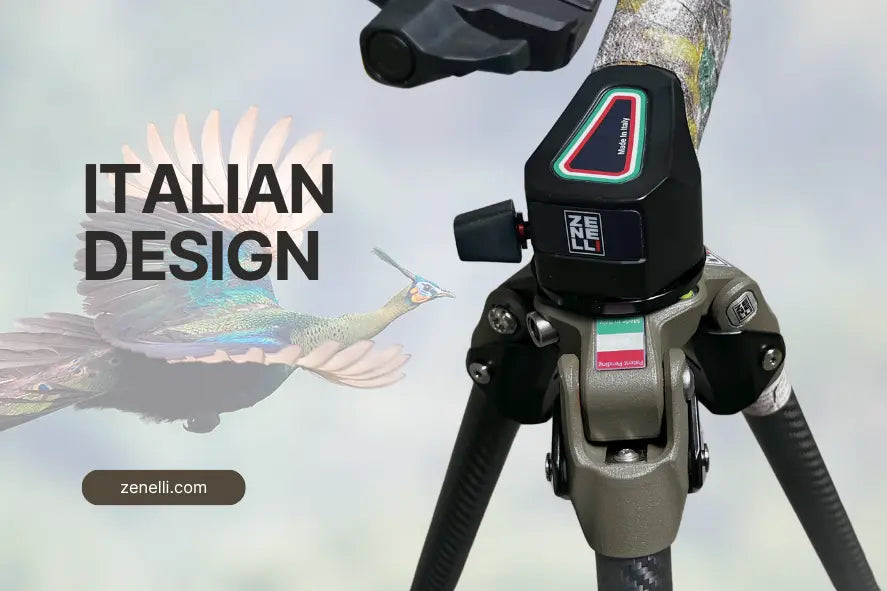
Italian Design: Where Form Meets Purpose
Italian design is often associated with style, but its meaning extends beyond appearance.
At its best, design is the process of bringing function, materials, engineering and form together within the same object.
The result should not simply look considered. It should work naturally, communicate its purpose and remain effective throughout its use.
This approach is central to the way Zenelli develops professional photographic equipment in Italy.
Design Begins with Function
Before defining the shape of a component, its function needs to be understood.
A gimbal head must support and balance a telephoto lens while allowing controlled movement. A tripod must transfer loads efficiently through its structure while remaining practical to carry. A lens foot must provide a secure mechanical connection without adding unnecessary mass.
These functional requirements influence dimensions, geometry, materials and manufacturing processes.
Form develops around these requirements rather than being applied to the product afterwards.
Materials Are Part of the Design
Different materials solve different engineering problems.
Carbon fiber can provide high structural efficiency at relatively low mass. Aluminum alloys can be precisely machined to create accurate mechanical interfaces. Magnesium alloys can provide another combination of low density and structural properties for selected components. Stainless steel can be appropriate where wear resistance and mechanical durability are required.
The important question is not which material sounds more advanced.
It is which material is appropriate for the function of each component.
For Zenelli, material selection is therefore part of the design process rather than simply a product specification.
Engineering and Aesthetics Are Connected
The appearance of a technical product often reflects the decisions made during its engineering.
The proportions of a gimbal arm are related to the equipment it needs to support. The diameter of a tripod leg is connected to structural requirements. The shape of a control influences how it is operated.
When these elements are considered together, aesthetics can emerge naturally from function.
A component does not need additional complexity simply to communicate that it has been designed.
Its geometry can explain its purpose.
Precision Manufacturing Matters
A design exists digitally before it exists physically.
Turning that design into a functional product requires control over dimensions, tolerances, interfaces, surface treatments and assembly.
This is particularly important in photographic support equipment, where several mechanical components must work together repeatedly.
Bearings need appropriate interfaces. Clamps must hold equipment securely. Adjustment mechanisms must remain predictable. Components need to assemble correctly within the complete system.
Manufacturing precision is therefore not separate from design.
It is what allows the intended design to become a repeatable physical product.
Craftsmanship in Modern Manufacturing
Craftsmanship does not necessarily mean rejecting technology.
In modern precision manufacturing, craftsmanship can mean understanding how a component should be machined, inspected, assembled and finished rather than relying only on what appears on a drawing.
CNC machining provides repeatability and dimensional control, while human experience remains important in evaluating the finished component and the way different parts interact during assembly.
The two approaches complement each other.
Technology provides control over the process. Experience helps determine whether the result behaves as intended.
Why Proportion Matters
Technical products are defined by relationships between components.
A control that is too small may be difficult to operate. A structure that is unnecessarily large may add mass without providing a useful advantage. A component can be mechanically effective but poorly integrated with the rest of the system.
Proportion is therefore both an aesthetic and functional consideration.
This is particularly relevant for photographic equipment, where products are frequently carried, handled and adjusted directly by the photographer.
Good design should make these interactions feel natural.
Designed and Manufactured in Italy
Zenelli develops and manufactures its photographic support equipment in Italy.
Keeping engineering and manufacturing closely connected allows feedback from machining, assembly, testing and field use to return directly to the design process.
A component can be evaluated not only according to its CAD geometry, but according to how it is manufactured, assembled and used as part of the complete product.
This connection between design and production is an important part of the Zenelli approach.
From Individual Components to Complete Systems
A Zenelli product is rarely an isolated component.
Tripods, gimbal heads, ball heads, lens feet, quick-release plates and accessories interact with each other and with the photographer's camera and lens.
Designing these products as parts of a wider system makes interfaces particularly important.
Dimensions, mounting standards, adjustment ranges and mechanical connections need to work together.
This system approach is one reason design cannot be separated from engineering.
Where Form Meets Purpose
For Zenelli, Italian design is not about adding style to a finished technical product.
It begins earlier.
It means understanding the application, selecting appropriate materials, developing the geometry, manufacturing components accurately and refining how those components interact with the photographer.
The appearance of the finished product is part of that process, but not its only objective.
At Zenelli, form follows engineering, and engineering follows purpose.

