Custom Camera Tripods: Designed Around the Way You Work
Photographers do not all use a tripod in the same way.
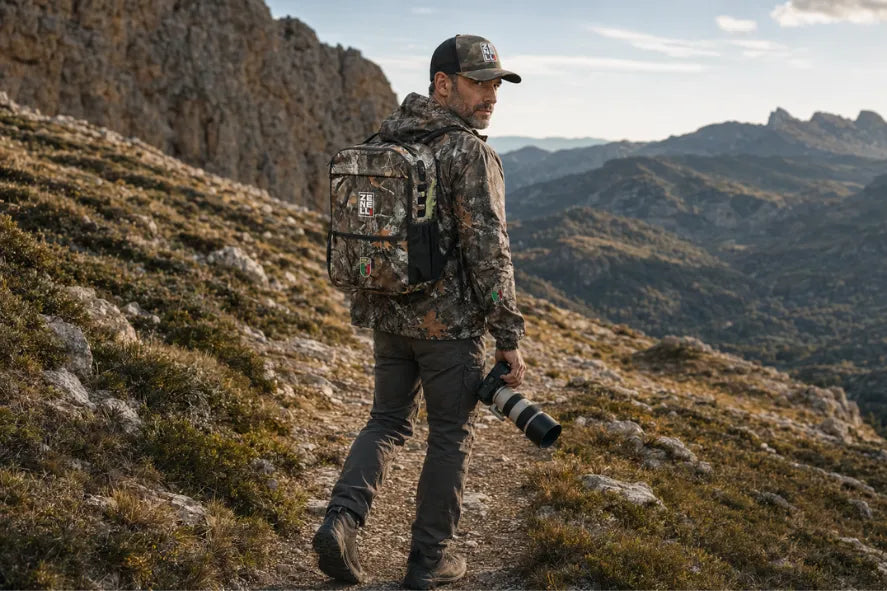
A wildlife photographer carrying a super-telephoto lens through the mountains has very different requirements from a landscape photographer travelling with limited luggage or a professional working from a fixed position with heavy optical equipment.
Height, folded dimensions, weight, rigidity, leg diameter and configuration can all become important depending on the application.
Standard tripods are designed to provide a practical compromise between these requirements. When that compromise does not fit a specific application, a custom tripod can be engineered around a different set of priorities.
Zenelli offers a Custom Tripod Service for photographers, filmmakers and professional applications requiring a carbon fiber support system with specifications that cannot be achieved with one of our standard configurations.
What Can Be Customized?
A custom tripod project starts with the application rather than an existing product configuration.
Depending on technical feasibility, parameters such as overall working height, folded length, number of leg sections, carbon fiber tube diameters, structural configuration, weight and transport dimensions can be evaluated.
Mechanical components, interfaces, surface finishes and application-specific features can also be considered when required.
These parameters are interconnected.
Increasing height, for example, can affect rigidity and transport dimensions. Reducing weight may require changes to tube dimensions or mechanical components. Adding another telescopic section can reduce folded length but also changes the structure of the leg.
For this reason, customization is not simply a matter of changing one dimension on an existing tripod.
Every Project Starts with the Application
The first step is understanding how and where the tripod will be used.
The equipment being supported, required working height, transport limitations, environmental conditions and expected use all help define the engineering requirements.
A photographer using a large super-telephoto lens from a relatively fixed position may prioritize rigidity and working height.
A photographer travelling long distances on foot may instead place greater importance on weight and folded dimensions.
Neither configuration is universally better. They represent different engineering priorities.
The objective of a custom project is to determine which combination is appropriate for the intended application.
Engineering Feasibility Comes First
Not every combination of dimensions, weight and performance is technically realistic.
A very tall tripod cannot simply be made indefinitely lighter without affecting other structural characteristics. Similarly, extremely compact folded dimensions may require additional leg sections or smaller tube diameters.
For this reason, every Zenelli custom tripod request is reviewed before a quotation is prepared.
Our engineering team evaluates the requested geometry, materials, structural requirements and manufacturing feasibility to determine whether the proposed configuration can be produced while maintaining appropriate mechanical performance and reliability.
If necessary, alternative solutions can be proposed when the original requirements conflict with one another.
Carbon Fiber Tubes and Leg Geometry
Carbon fiber is particularly useful in custom tripod design because tube dimensions and construction can be selected according to the structural requirements of the project.
However, carbon fiber alone does not determine the performance of a tripod.
Tube diameter, wall construction, telescopic overlap, number of sections and the mechanical connections between them all influence the behaviour of the complete leg.
A custom project therefore considers the carbon fiber tubes together with the tripod geometry rather than treating them as independent components.
This allows weight, rigidity, folded dimensions and working height to be evaluated as part of the same system.
Custom Mechanical Components
Some projects can be achieved by adapting existing Zenelli components. Others require dedicated mechanical parts.
Depending on the application, this may involve new CNC-machined components, different interfaces, dedicated carbon fiber tubes or modifications to the assembly.
Custom components also require their own manufacturing and inspection processes.
This is one of the main differences between configuring a standard tripod and developing a genuinely custom support system.
From Engineering to Manufacturing
Once a configuration has been technically defined, the project moves from engineering into manufacturing.
Zenelli custom tripod projects combine carbon fiber components with precision-machined mechanical parts and assembly in Italy.
Depending on the project, production may involve dedicated CNC machining, specific carbon fiber components, surface treatments, assembly and dimensional or functional inspection.
Because these operations are carried out for an individual configuration rather than normal series production, custom projects generally require different production times and costs from standard products.
Custom Tripods Beyond Photography
The same approach can also be applied outside traditional photography.
Carbon fiber support structures can be useful for optical equipment, measurement systems, imaging equipment, research applications and other professional installations where low weight and structural rigidity are important.
Zenelli can therefore evaluate custom tripod and support-system projects for companies, research organizations and OEM applications as well as individual photographers.
The engineering requirements remain the starting point in every case.
When Does a Custom Tripod Make Sense?
A custom tripod becomes particularly relevant when an important requirement cannot be adequately addressed by a standard model.
This may involve an unusual working height, specific folded dimensions, transport restrictions, a particular leg configuration, specialized equipment or an application outside conventional photography.
If a standard tripod already meets the requirements, customization may offer little practical advantage.
If it does not, designing the support around the application can provide a more appropriate solution than adapting the application to an unsuitable standard product.
Tell Us About Your Project
The best starting point for a custom tripod request is a clear description of the application.
Tell us what equipment the tripod needs to support, the required working height, any limits on weight or folded dimensions, the environment in which it will operate and any specific mechanical requirements.
Our engineering team can then evaluate the request, determine its technical feasibility and, when the project is viable, prepare a dedicated proposal and quotation.
A custom tripod is not simply a standard tripod with different dimensions. It is a support system in which geometry, materials and mechanical components are evaluated around a specific application.