Aluminum Gimbal Head for Telephoto Lenses: Precision, Strength and Control
Large telephoto lenses require more from a tripod head than simply the ability to support their weight.
As the dimensions and mass of the camera system increase, balance, rigidity and controlled movement become increasingly important. The photographer needs to reposition the lens smoothly while maintaining predictable control throughout pan and tilt movements.
An aluminum gimbal head is designed specifically around these requirements.
Why Use a Gimbal Head with a Telephoto Lens?
A gimbal head supports the camera and lens around their center of gravity.
When correctly adjusted, the weight of the equipment is balanced around the tilt axis. This reduces the effort required to move a large telephoto lens and makes it easier to start, stop and change direction.
The advantage becomes particularly noticeable during wildlife, bird and sports photography, where the photographer may need to follow a moving subject continuously through a long lens.
The purpose of the gimbal is not to eliminate the physical weight of the equipment, but to manage that weight mechanically.
Why Aluminum Is Used in Gimbal Construction
Aluminum combines relatively low density with good mechanical strength and excellent machinability.
This makes it particularly suitable for components that require accurate dimensions, bearing seats, threaded connections and precise mechanical interfaces.
Different aluminum alloys and manufacturing processes can also be selected according to the function of individual components.
In a gimbal head, the material is therefore only part of the equation. Geometry, machining accuracy and the way individual components are connected determine how the complete structure behaves under load.
Rigidity Matters with Long Lenses
A large telephoto lens creates leverage above the tripod.
When the photographer accelerates, stops or changes direction, forces are transferred through the lens foot, clamp, gimbal structure and tripod.
Structural rigidity helps maintain predictable alignment between these components.
This is why maximum load capacity alone cannot describe the performance of a gimbal head.
A head must not only support the static weight of the equipment. It must also provide sufficient structural control while the camera and lens are moving.
Bearings and Controlled Movement
The rotational system is one of the most important parts of a gimbal head.
Pan controls horizontal movement, while the tilt axis controls vertical movement. For tracking photography, these movements need to work together predictably.
Bearings can help reduce rotational resistance and provide consistent movement around the axes.
The objective is not necessarily to make the head move with the lowest possible resistance.
Movement should instead be smooth, progressive and controllable according to the camera system and the subject being photographed.
Balance Before Friction
Friction should not be used to compensate for an incorrectly balanced lens.
The camera and lens should first be positioned so that their center of gravity is correctly aligned with the gimbal's tilt axis.
Once the system is balanced, resistance can be adjusted according to the photographer's preference.
This approach allows friction to control movement rather than fight against the weight of the lens.
For fast-moving subjects, relatively free movement may be preferred. For slower or more controlled positioning, additional resistance can provide a different feel.
Precision-Machined Components
CNC machining allows critical gimbal components to be manufactured with controlled dimensions and repeatable mechanical interfaces.
This is particularly important around pivots, clamps, adjustment mechanisms and bearing locations.
Forged aluminum components can also be used where the manufacturing process and geometry provide appropriate mechanical characteristics for the application.
The value of these processes is not simply their technical complexity.
They allow the mechanical architecture of the gimbal to be designed around specific structural and functional requirements.
Adjustment Range Is Part of the Design
Telephoto lenses vary considerably in size, weight and center of gravity.
A gimbal head must therefore provide sufficient adjustment to position different camera and lens combinations correctly.
Longitudinal adjustment allows the lens to move forward and backward, while vertical adjustment allows its center of gravity to be positioned relative to the tilt axis.
This is particularly important with large super-telephoto lenses, where the correct balance point may change when the camera body, teleconverter or other accessories are changed.
Aluminum or Carbon Fiber Gimbal Head?
Aluminum and carbon fiber can both be used effectively in professional gimbal construction, but they offer different engineering possibilities.
Aluminum is particularly suitable for precision-machined components and provides a strong, proven structural solution.
Carbon fiber can provide a high stiffness-to-weight ratio when incorporated correctly into the load-bearing structure.
The choice should therefore not be based on the assumption that one material is universally better.
Photographers should consider total weight, dimensions, adjustment range, rigidity, movement and the intended use of the complete support system.
The Zenelli Aluminum Gimbal Approach
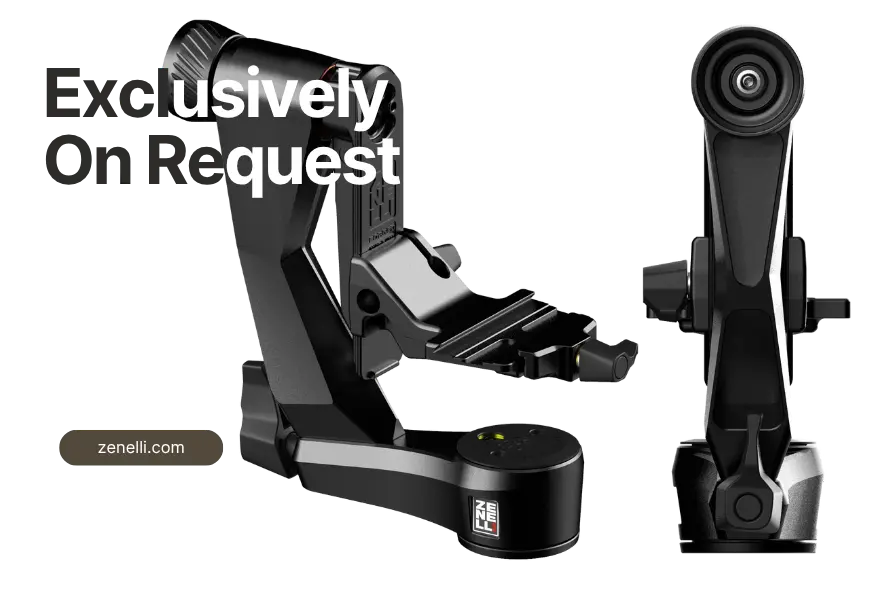
Zenelli aluminum gimbal heads combine precision-machined components, controlled rotational systems and adjustment mechanisms developed for telephoto photography.
The design objective is to create a mechanical system in which the lens can be correctly balanced and then moved through predictable pan and tilt movements.
Material selection, structural geometry, bearings and adjustment range work together as parts of the same system.
For the photographer, the result should be simple: the equipment is supported securely while remaining controllable throughout the required range of movement.
Managing the Weight, Not Just Supporting It
A gimbal head for telephoto photography should not be evaluated only by how much weight it can hold.
The more useful questions are whether the lens can be correctly balanced, whether the structure remains sufficiently rigid and whether movement remains predictable while tracking a subject.
These characteristics determine how effectively the photographer can control a large camera system in real use.
The purpose of an aluminum gimbal head is therefore not simply to support a heavy telephoto lens. It is to manage its weight through balance, structural rigidity and controlled movement.