CARBON LFZ: Carbon Fiber Lens Foot for Nikon Z Telephoto Lenses
A lens foot is a small component, but with a telephoto or super-telephoto lens it performs an important mechanical function.
It creates the connection between the lens and the support system, transferring the load to the tripod head while also influencing mounting, balance and handling.
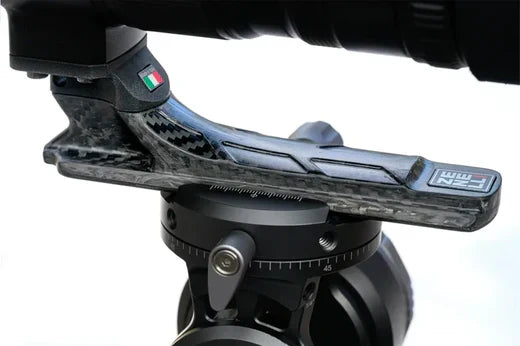
The Zenelli CARBON LFZ is designed specifically for compatible Nikon Z telephoto lenses, combining a carbon fiber structure with an integrated support interface for photographers working with long lenses.
Why the Lens Foot Matters
Large telephoto lenses are normally supported from the lens rather than from the camera body.
This places the lens foot directly in the structural path between the equipment and the tripod head.
Its geometry, rigidity and mounting interface therefore contribute to the behaviour of the complete support system.
A lens foot should provide a secure connection while allowing the lens to be positioned correctly on the head being used.
With a gimbal head, this becomes particularly important because longitudinal positioning is required to balance the camera and lens around the tilt axis.
Designed for Nikon Z Telephoto Lenses
The CARBON LFZ is developed around compatible Nikon Z telephoto lenses rather than as a universal adapter.
A dedicated lens foot allows the geometry of the component to be designed around the mounting points and dimensions of the intended lens.
This provides a more integrated solution than adding a separate plate beneath the original lens foot.
For photographers using substantial Nikon Z telephoto equipment, reducing the number of additional components can also help create a cleaner and more compact setup.
Carbon Fiber as a Structural Material
Carbon fiber is used in the CARBON LFZ as part of the load-bearing structure.
Its high stiffness-to-weight potential makes it particularly suitable for a component where structural performance and low mass are both important.
The objective is not simply to replace metal with carbon fiber.
The complete geometry of the lens foot must be designed around the characteristics of the material so that the component provides the required support without introducing unnecessary mass.
This becomes particularly relevant when the lens, camera, tripod and head already create a substantial equipment package.
Integrated Arca-Swiss Compatible Profile
The CARBON LFZ incorporates an Arca-Swiss compatible profile, allowing the lens foot to connect directly to compatible tripod and gimbal clamps.
This eliminates the need to install a separate Arca-Swiss plate beneath the original lens foot.
A direct interface reduces the number of components between the lens and the support system and keeps the overall configuration more compact.
It also allows longitudinal positioning within a compatible clamp, an important function when balancing a telephoto lens on a gimbal head.
Balancing a Nikon Telephoto Lens on a Gimbal
Correct balance depends on the complete camera and lens configuration.
The camera body, lens, teleconverter and other accessories can change the position of the center of gravity.
With an Arca-Swiss compatible lens foot, the complete assembly can be moved forward or backward within the gimbal clamp until the appropriate longitudinal balance position is reached.
The gimbal's vertical adjustment can then be used to align the system relative to the tilt axis.
The lens foot therefore plays a direct role in the balancing process rather than simply attaching the lens to the head.
Lower Weight Where It Matters
Reducing the weight of a single component may appear insignificant when compared with a large telephoto lens.
But wildlife photographers often carry a complete system consisting of camera, lens, tripod, head and accessories.
Reducing unnecessary mass across several components can make the complete setup easier to transport.
A lightweight lens foot is particularly useful because it remains permanently attached to the lens and moves with the equipment whether the photographer is shooting, carrying or travelling.
Designed as Part of the Support System
The CARBON LFZ should not be considered independently from the equipment around it.
The lens connects to the foot. The foot connects to the clamp. The clamp connects to the gimbal or tripod head, which transfers the load to the tripod.
Each interface contributes to the complete mechanical chain.
For this reason, Zenelli develops its carbon fiber lens feet as components of a wider camera support system rather than simply as replacement accessories.
From Lens to Support
A telephoto lens foot performs several functions at the same time.
It supports the lens, provides the mounting interface and allows the position of the equipment to be adjusted relative to the tripod head.
With a gimbal, that final function becomes particularly important because correct positioning is fundamental to achieving balance.
The Zenelli CARBON LFZ combines a lightweight carbon fiber structure with an Arca-Swiss compatible interface designed to connect compatible Nikon Z telephoto lenses directly to the photographic support system.