Carbon Fiber Gimbal Head for Super-Telephoto Lenses: Balance, Stability and Control
Using a 400mm, 500mm or 600mm super-telephoto lens changes the mechanical requirements of a camera support system.
These lenses combine substantial mass with a center of gravity positioned away from the camera body. Supporting that weight is only part of the problem. The photographer also needs to position the lens accurately and, in wildlife or bird photography, move it quickly enough to follow unpredictable subjects.
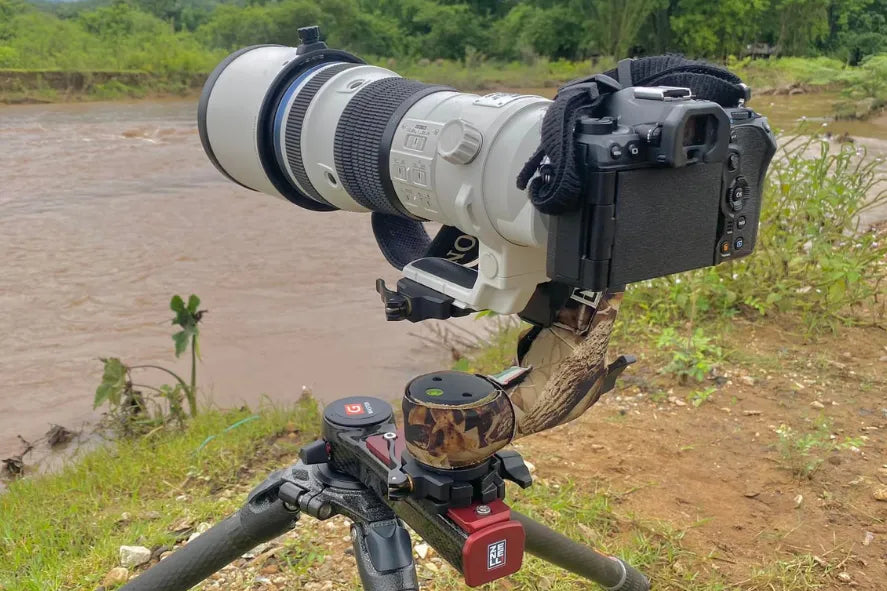
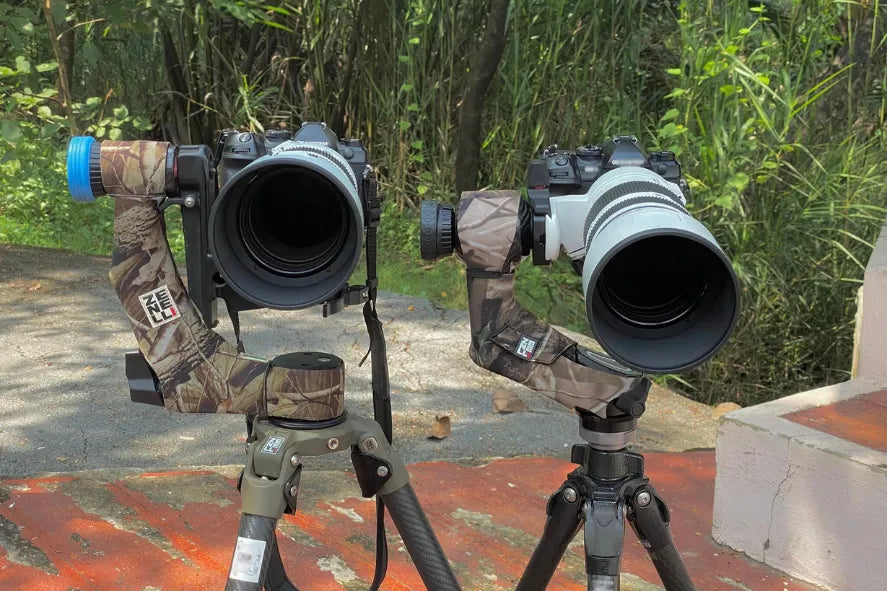
A gimbal head addresses these requirements by allowing the camera and lens to be balanced around the head's tilt axis.
When correctly adjusted, the system supports the weight of the equipment while allowing controlled pan and tilt movement.
Why Super-Telephoto Lenses Need a Different Support Approach
A large telephoto lens behaves differently from a camera equipped with a shorter and lighter lens.
Its mass is distributed over a longer structure, and the lens is normally supported through its tripod collar and lens foot rather than through the camera body.
This changes the way the equipment interacts with the tripod head.
The challenge is therefore not simply finding a head capable of carrying the specified weight.
The support needs to accommodate the dimensions and center of gravity of the complete camera and lens combination while providing the movement required by the photographer.
How Does a Gimbal Head Work?
A gimbal head is designed to position the camera and lens so that their center of gravity can be aligned with the tilt axis of the head.
Longitudinal adjustment moves the equipment forward or backward.
Vertical adjustment positions the center of gravity relative to the tilt axis.
When these adjustments are correctly made, the lens becomes substantially easier to control because the photographer is no longer continuously working against a strongly unbalanced load.
The purpose of the gimbal is therefore not to make the equipment lighter.
It is to manage its weight through balance.
Balance Comes Before Friction
Friction should not be used to compensate for an incorrectly balanced telephoto lens.
If the lens continually falls forward or backward when the tilt control is released, its center of gravity is not correctly positioned relative to the gimbal.
The first step should be to establish mechanical balance.
Friction can then be added according to the photographer's preference to control the feel of the movement.
This distinction becomes particularly important with large 400mm, 500mm and 600mm lenses, where an unbalanced system can require considerable resistance simply to remain in position.
Why Balance Matters for Wildlife Photography
Wildlife photography often alternates between waiting and sudden movement.
A bird may remain stationary for several minutes and then take flight. An animal can change direction without warning. The photographer needs a support that can hold the equipment while waiting but also allow immediate movement when the situation changes.
A correctly balanced gimbal makes this transition easier.
The lens remains supported while the photographer can pan horizontally and tilt vertically to follow the subject.
This is why gimbal heads are particularly associated with bird, wildlife and sports photography using long lenses.
Tracking Birds and Moving Wildlife
Following a moving subject requires more than unrestricted movement.
The movement needs to be predictable.
Excessive resistance can make it difficult to follow rapid changes in direction, while a system that moves too freely may be harder to control precisely.
Bearing design, friction adjustment, structural rigidity and correct balance all contribute to the behaviour of the head.
For the photographer, the objective is to find a configuration that allows the lens to move when required and remain controllable throughout the movement.
Why Use Carbon Fiber in a Gimbal Head?
Carbon fiber offers a high stiffness-to-weight potential, making it useful for structural components where both rigidity and low mass are important.
For a gimbal head, reducing unnecessary weight can be particularly valuable because the photographer may already be carrying a large telephoto lens, camera body and tripod.
However, carbon fiber alone does not determine how a gimbal performs.
Laminate design, geometry, bearings, metal interfaces, adjustment mechanisms and the connections between components all influence the behaviour of the finished head.
A carbon fiber gimbal should therefore be evaluated as a complete mechanical system rather than simply by the material used in its structure.
Carbon Fiber and Vibration
It is sometimes stated that carbon fiber automatically absorbs vibration better than metal.
The behaviour of a complete camera support system is more complex.
Vibration depends on structural stiffness, mass distribution, geometry, joints, interfaces, tripod characteristics and the camera and lens mounted on the system.
Material properties contribute to this behaviour, but they cannot be considered independently from the complete structure.
For super-telephoto photography, the relevant question is therefore how the entire support system behaves with the actual equipment mounted on it.
Rigidity Remains Essential
Reducing weight is useful only if the gimbal maintains the structural characteristics required by the application.
A large telephoto lens can create significant loads around the head because its mass extends away from the mounting interfaces.
Flexibility or movement within the structure can affect the relationship between the lens and the axes of the gimbal.
For this reason, the geometry and construction of the head are as important as the material from which it is made.
Lightweight engineering is not simply about using less material. It is about placing material where it contributes effectively to the structure.
Choosing a Gimbal for a 400mm, 500mm or 600mm Lens
Focal length alone does not determine which gimbal head is appropriate.
A 600mm prime lens and a smaller zoom lens that reaches 600mm can have very different dimensions, weight and center-of-gravity positions.
The complete setup should be considered.
The gimbal needs sufficient load capacity, but it also needs enough longitudinal and vertical adjustment to place the specific camera and lens combination in the correct balance position.
The lens foot or quick-release plate is part of this equation because its length and position determine how far the equipment can move within the clamp.
Full-Size and Compact Gimbal Heads
Not every super-telephoto setup requires the same gimbal architecture.
A full-size gimbal can provide a wide adjustment range for large prime lenses and demanding camera configurations.
A more compact gimbal may be appropriate where reducing overall size and weight is a priority and the dimensions of the camera and lens remain within its adjustment range.
The appropriate choice therefore depends on the complete equipment configuration and the way the photographer intends to use it.
The Tripod Is Part of the System
A gimbal cannot provide a stable platform independently of the tripod beneath it.
Tripod rigidity, leg diameter, working height, section design, locking mechanisms and ground conditions all contribute to the behaviour of the complete setup.
The connection between lens foot and gimbal is equally important.
For this reason, supporting a super-telephoto lens should be approached as a system consisting of the lens foot or plate, gimbal head and tripod rather than as three unrelated products.
Stability Through Balance
A carbon fiber gimbal head does not make a large telephoto lens weightless, nor does carbon fiber alone guarantee stability.
The mechanical advantage comes from combining appropriate structural design with correct balance and controlled movement.
When the camera and lens are correctly positioned around the gimbal's axes, the support carries the load while the photographer controls where the lens points.
For 400mm, 500mm and 600mm super-telephoto lenses, the primary advantage of a well-designed carbon fiber gimbal head is the ability to combine low support-system weight with correct balance, structural rigidity and controlled movement for wildlife, bird and sports photography.