

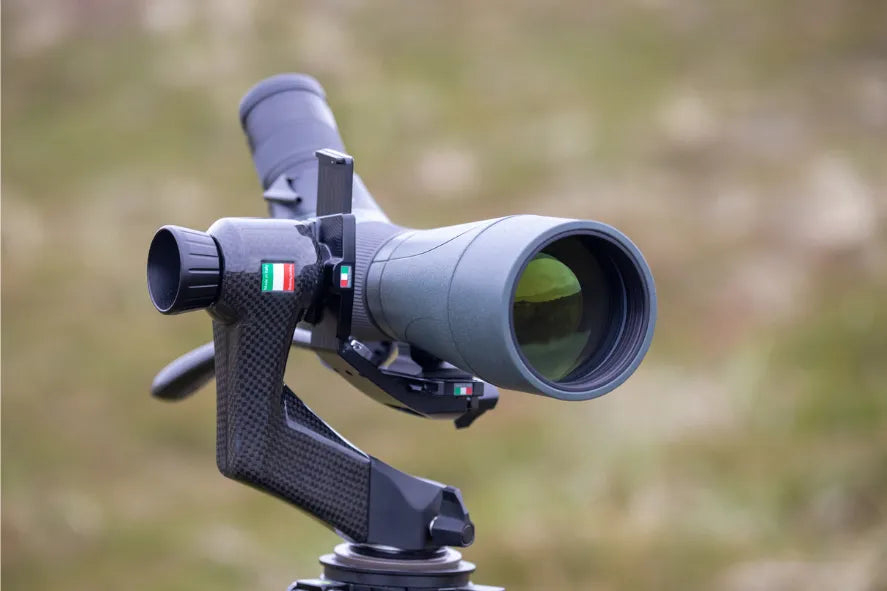
Best Gimbal Head for Bird Photography
Bird photography places unusual demands on a camera support system.
Birds can remain completely still for several minutes and then change position or take flight without warning. The photographer may need precise framing one moment and fast, continuous tracking the next.
When long telephoto lenses are involved, the tripod head must therefore do more than simply support the weight of the equipment. It must allow the camera and lens to move naturally while remaining controlled throughout the movement.
For this type of photography, a gimbal head can provide a significant practical advantage.
Why Use a Gimbal Head for Bird Photography?
A gimbal head is designed to support a telephoto lens around its balance point.
When the camera and lens are correctly positioned, the system can move in both pan and tilt with much less effort than an unbalanced support.
This is particularly useful in bird photography because the photographer frequently needs to change direction while maintaining the subject within the frame.
The purpose of the gimbal is not simply to hold a heavy lens. It is to make that lens easier to control while it is moving.
Balance Is the Starting Point
Correct balance is one of the most important aspects of using a gimbal head.
The camera and lens should be positioned so that the complete system remains as neutral as possible when the photographer releases pressure from the equipment.
If the lens continually falls forward or backward, the longitudinal position needs adjustment.
If the system is correctly balanced, less force is required to initiate, stop or reverse movement.
This makes tracking more predictable and reduces the need to compensate continuously for the weight of the lens.
Tracking Birds in Flight
Birds in flight can change speed, direction and altitude rapidly.
The gimbal head must allow the photographer to follow these movements without introducing unnecessary resistance.
Horizontal panning controls movement from side to side, while the tilt axis allows the lens to follow subjects moving higher or lower in the frame.
When these two movements work together, the photographer can follow a bird through a continuous trajectory rather than repeatedly repositioning the camera.
For this reason, smooth movement and appropriate friction adjustment are particularly important for birds-in-flight photography.
Friction Should Provide Control, Not Resistance
A gimbal does not always need to move completely freely.
A small amount of controlled friction can help prevent unwanted movement while still allowing the photographer to follow the subject naturally.
Too much resistance can make rapid direction changes difficult. Too little resistance can make the system feel excessively loose, particularly with large lenses.
The appropriate setting depends on the lens, camera, balance and type of subject being photographed.
The objective is to find a level of resistance that allows movement to begin and stop predictably.
Prime Lenses and Telephoto Zooms
Bird photographers use a wide range of lenses, from relatively compact telephoto zooms to large super-telephoto primes.
A 100–400mm or similar zoom may prioritize mobility and rapid repositioning, while lenses such as a 400mm, 500mm or 600mm prime place greater demands on the dimensions and adjustment range of the gimbal.
Large zooms such as a 200–600mm occupy a position between these two categories, combining significant reach with the flexibility of variable focal length.
The important consideration is not simply focal length or lens weight.
The gimbal must provide sufficient adjustment range to correctly position the center of gravity of the complete camera and lens combination.
Full Gimbal or Compact Gimbal?
Not every bird photographer requires the same gimbal architecture.
A full-size gimbal can provide a large adjustment range and is particularly suitable for substantial super-telephoto systems.
A more compact gimbal can reduce the size and weight of the support system while still providing controlled pan and tilt movement when its adjustment range is appropriate for the equipment being used.
The choice depends on lens dimensions, weight, balance point, transport requirements and the photographer's preferred way of working.
A larger gimbal is not automatically better, just as a smaller gimbal is not automatically more practical.
The head must match the equipment.
Weight Matters When You Carry the Equipment
Bird photography frequently involves moving between locations with the camera, lens, tripod and head already assembled or carried together.
In these situations, the weight of the gimbal becomes part of the total equipment load.
Reducing the mass of the head can make the complete support system easier to transport, particularly during long walks or repeated changes of shooting position.
This is one reason carbon fiber can be useful in gimbal construction when it forms part of a properly engineered load-bearing structure.
The relevant advantage is not carbon fiber by itself, but the possibility of achieving an effective relationship between structural performance and weight.
Gimbal Head or Ball Head for Bird Photography?
Both types of head can be used in bird photography, but they are designed around different priorities.
A ball head provides compact, multidirectional positioning and can be a practical solution when portability and versatility are important.
A gimbal head is specifically suited to controlled movement with larger telephoto equipment because the lens can be positioned around its balance point.
For photographers who frequently track moving birds with long lenses from a tripod, this difference can become particularly significant.
What Should You Look for in a Bird Photography Gimbal?
The appropriate gimbal should allow the camera and lens to be correctly balanced throughout the required range of movement.
It should provide sufficient vertical and longitudinal adjustment for the intended lens, predictable pan and tilt movement, appropriate friction control and a secure interface with the lens foot or quick-release plate.
Weight and transport dimensions also become important when the equipment is regularly carried in the field.
These characteristics should be evaluated together rather than selecting a gimbal from maximum load capacity alone.
Choosing the Right Gimbal Head for Bird Photography
There is no single gimbal head that is ideal for every bird photographer.
The appropriate choice depends on the lens, camera, type of subjects, amount of equipment carried and whether the photographer prioritizes maximum adjustment range or a more compact support system.
For large super-telephoto lenses, the ability to correctly balance and control the complete camera system is particularly important.
For lighter telephoto combinations, portability may become a greater priority.
The best gimbal head for bird photography is therefore the one that allows your specific camera and lens combination to remain balanced, controlled and easy to move while following unpredictable subjects in the field.

