What Motorsport Engineering Taught Us About Designing a Carbon Fiber Tripod
Carbon fiber is often associated with lightweight equipment.
But reducing weight is only one reason to use a composite material.
In high-performance engineering, including motorsport, the more important question is how a structure behaves under load: how much it flexes, where it flexes, how efficiently forces are transferred and how effectively unwanted movement is controlled.
These same questions become surprisingly relevant when designing a professional tripod for wildlife photography.
A tripod supporting a large telephoto lens is not simply carrying weight. It is a structural system subjected to changing forces every time the photographer moves the camera, pans with a subject or works in windy conditions.
This engineering approach influenced the development of the Zenelli Carbon TX34.
From Motorsport to Photographic Support
Motorsport components are often designed around competing requirements.
Weight needs to be reduced, but stiffness and reliability must remain appropriate for the application. Materials therefore cannot be evaluated independently from geometry, dimensions and the forces acting on the complete structure.
The same principle applies to a tripod.
Making a tripod lighter is relatively easy if material is simply removed. Making it lighter while maintaining the required structural behaviour is a much more complex engineering problem.
For Zenelli, this distinction is fundamental.
The objective is not minimum weight by itself. It is structural efficiency: using materials and geometry effectively to achieve the required relationship between weight, rigidity and field performance.
Why Super-Telephoto Lenses Change the Problem
Long and super-telephoto lenses place particular demands on a support system.
Their physical dimensions create leverage, while their narrow angle of view makes small movements much more noticeable in the frame.
For this reason, maximum load capacity alone provides limited information about how a tripod will behave with a large lens.
A tripod may safely support the static weight of the equipment while still allowing unwanted rotational or structural movement during use.
For wildlife photography, this means that rigidity and control of movement can be more informative than a load figure considered in isolation.
Torsional Rigidity Matters
Vertical stiffness is only one aspect of tripod behaviour.
When a photographer pans a large lens or changes direction, rotational forces are transmitted through the head, tripod platform, leg joints and telescopic sections.
This is where torsional rigidity becomes important.
If the structure twists under these forces, the camera may continue moving slightly even after the photographer has stopped applying input.
The engineering challenge is therefore to create a tripod structure that resists unwanted torsional deformation while remaining practical to carry and operate in the field.
The TX34 Approach
The Zenelli TX34 uses four-section carbon fiber legs with a first tube diameter of 32.5 mm.
The TX34 reaches a maximum height of 1379 mm, folds to 529 mm and weighs approximately 1.71 kg, with a specified maximum load of 35 kg.
But these numbers describe only part of the product.
The TX architecture combines carbon fiber tubes with precision-machined structural components and a wide tripod cross designed around stability. The telescopic leg system also incorporates sealing elements and pressure-relief valves, while the locking mechanism allows the sections to be secured through a single operating movement.
The objective is to make the different components function as a single mechanical structure rather than optimize one specification independently from the others.
Why There Is No Center Column
The TX architecture does not rely on a conventional extendable center column for normal height adjustment.
This keeps the camera load connected more directly to the tripod structure and avoids introducing another extended structural element between the head and the legs.
For a tripod intended primarily for demanding telephoto applications, this reflects a deliberate priority: rigidity and structural simplicity before maximum height convenience.
Other photographic applications may benefit from a center column. The TX follows a different set of priorities.
Engineering Is About Trade-Offs
There is no single ideal tripod geometry for every photographer.
Increasing tube diameter can improve structural rigidity but may increase dimensions and mass. Increasing the number of leg sections can reduce folded length but introduces additional mechanical interfaces. Extending smaller leg sections changes the behaviour of the structure compared with operating the tripod at a lower height.
This is why the TX34 was not designed around achieving an extreme value for one specification.
Its dimensions, carbon fiber structure, leg geometry and mechanical components were developed as parts of the same system.
This way of thinking has much in common with high-performance engineering: optimize the complete structure rather than a single number.
Independently Tested by PHOTOGRAPHIE
In 2026, the Zenelli TX34 was independently evaluated by German photography magazine PHOTOGRAPHIE.
The test appeared in the July–August 2026 issue, where the TX34 was featured under the title “Ein Dreibein für höchste Ansprüche” — a tripod for the highest demands.
An independent field evaluation is particularly relevant because tripod performance cannot be understood completely from specifications alone.
Weight, tube diameter, maximum load and height can be measured easily. The behaviour of the complete support system during actual photographic use must also be experienced and evaluated in the field.
The independent evaluation of the TX34 therefore provides an external perspective on a product developed around structural efficiency, rigidity and the practical requirements of photographers working with demanding equipment.
Designed for Long-Lens Photography
The TX34 is part of the Zenelli Carbon TX family, developed for wildlife, bird, sports and outdoor photographers working with telephoto equipment.
Its design priorities reflect that intended application.
Rather than trying to create a universal tripod for every photographic discipline, the TX configuration emphasizes structural rigidity, rapid operation and a stable platform for demanding camera and lens combinations.
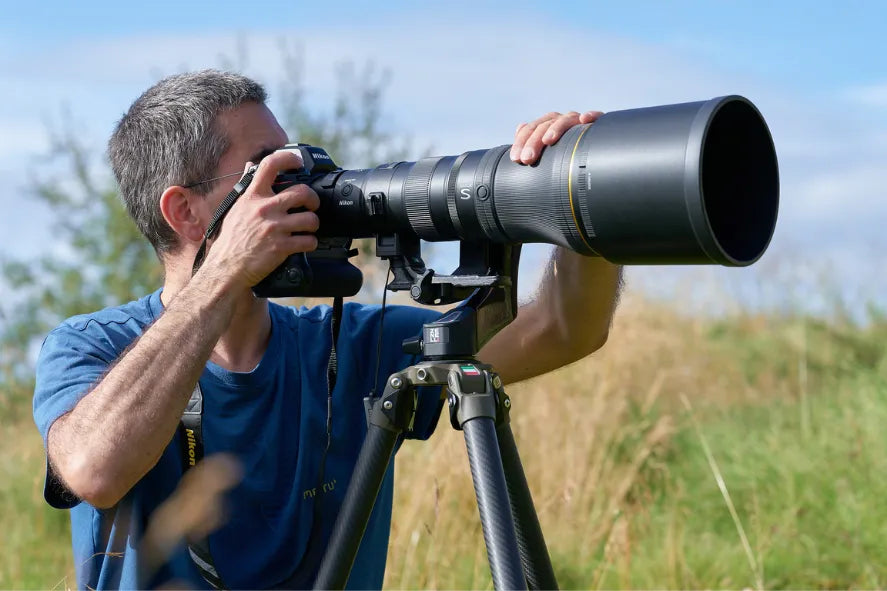
This becomes particularly relevant when a gimbal head and large telephoto lens are added above the tripod, increasing both the mass and leverage acting on the support.
Engineering Before Specifications
The connection between motorsport engineering and wildlife photography is not that a tripod behaves like a racing car component.
It is the engineering method behind the two applications.
Define the loads. Understand how the structure behaves. Select appropriate materials. Design the geometry around those materials. Control unnecessary mass. Evaluate the complete system rather than optimizing an isolated specification.
That philosophy influenced the development of the Zenelli TX34.
For a professional carbon fiber tripod, the important question is not simply how much weight it can support. It is how efficiently the complete structure controls that equipment while the photographer is actually using it.