How to Choose the Best Carbon Fiber Tripod for Wildlife Photography and Super-Telephoto Lenses
Choosing a carbon fiber tripod for wildlife photography involves more than comparing maximum load capacity, weight or tube diameter.
When working with telephoto and super-telephoto lenses, the tripod becomes part of a complete support system that must provide sufficient rigidity while remaining practical to carry, transport and deploy in the field.
The best tripod is therefore not necessarily the lightest or the one with the highest load rating. It is the one that provides the right balance between stability, weight, working height, transport dimensions and speed of operation for the photographer and equipment being used.
Start with the Lens and the Way You Work
A tripod should be selected around the equipment it will support and the conditions in which it will be used.
A photographer working from a hide with a large super-telephoto lens may prioritize rigidity and working height because the equipment will remain in approximately the same position for extended periods.
A wildlife photographer walking several kilometres between locations may accept different compromises in order to reduce weight and transport dimensions.
Bird photography can introduce another requirement: the ability to reposition the camera quickly when a subject suddenly changes direction or location.
There is no single specification that determines which tripod is best for all of these situations.
Load Capacity Does Not Tell the Whole Story
Maximum load capacity indicates how much weight a tripod is designed to support, but it does not describe every aspect of its mechanical behaviour.
A tripod can safely support a heavy camera and lens while still allowing some structural movement when the photographer pans, changes direction or works in windy conditions.
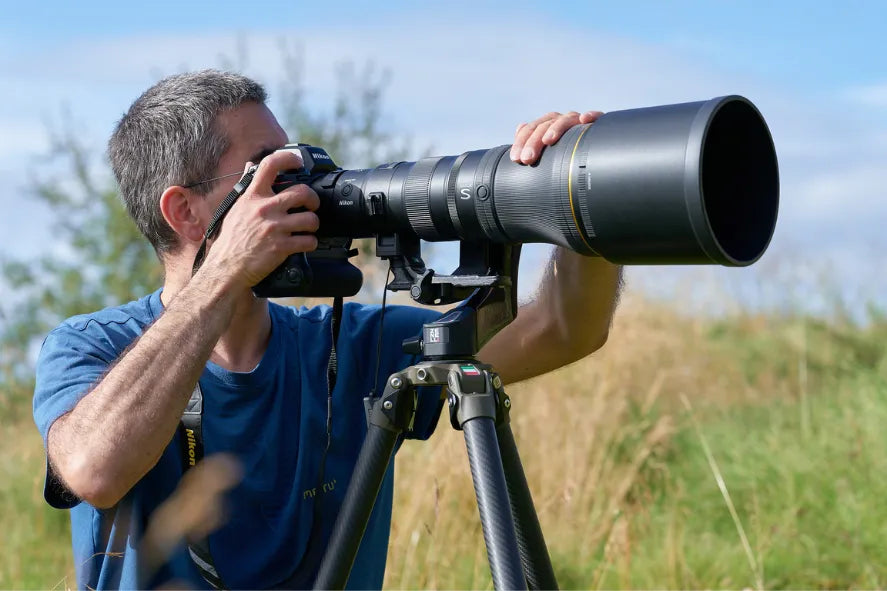
This is particularly relevant with large telephoto lenses because their length creates leverage above the tripod.
For this reason, photographers using long lenses should consider structural rigidity and the behaviour of the complete support system rather than choosing a tripod based only on its maximum load rating.
Weight and Rigidity Must Be Considered Together
Reducing tripod weight is valuable for wildlife photographers who carry their equipment over long distances.
But minimum weight should not be the only objective.
Removing material or reducing tube dimensions can make a tripod easier to carry while also changing its structural behaviour.
The engineering challenge is to achieve an effective relationship between weight and rigidity.
Carbon fiber is particularly suitable for this type of application because its construction can be optimized around structural requirements while maintaining relatively low mass.
For the photographer, this means that tripod weight should always be evaluated together with the equipment being supported and the conditions in which the tripod will be used.
Leg Diameter and Number of Sections
The geometry of the tripod legs has a direct influence on both portability and structural performance.
Larger-diameter tubes can contribute to increased rigidity, while additional telescopic sections can reduce the folded length of the tripod.
These characteristics create different design priorities.
A four-section tripod can provide a compact transport configuration while still reaching a useful working height. However, the diameter of the individual sections, their overlap and the mechanical connections between them also contribute to the behaviour of the complete leg.
Tube diameter alone should therefore not be considered independently from the rest of the tripod design.
Working Height Matters
A tripod needs to reach a practical working height without forcing the photographer into an uncomfortable position.
Maximum height, however, should not be considered in isolation.
As telescopic legs are extended and smaller sections come into use, the mechanical behaviour of the tripod changes. In difficult conditions, using only the height that is actually required can provide a more rigid setup than automatically extending every section completely.
The appropriate working height also depends on the tripod head and camera or lens mounted above it.
When comparing tripods, consider the height of the complete photographic system rather than the tripod alone.
Transport Size Can Be Just as Important
Wildlife photography often requires equipment to be carried through forests, mountains, wetlands or other environments where compact dimensions become important.
Folded length affects how easily a tripod can be attached to a backpack, transported in luggage or carried through vegetation.
A compact tripod can therefore offer a significant practical advantage even when two models have similar working heights.
The ideal relationship between folded length and maximum height depends on how frequently the tripod is transported and how far the photographer normally carries it.
Deployment Speed in the Field
Wildlife does not always wait for equipment to be prepared.
The design of the leg locks and the way the tripod opens can influence how quickly the photographer moves from transport to shooting.
A good locking system should be fast to operate, secure when engaged and predictable over repeated use.
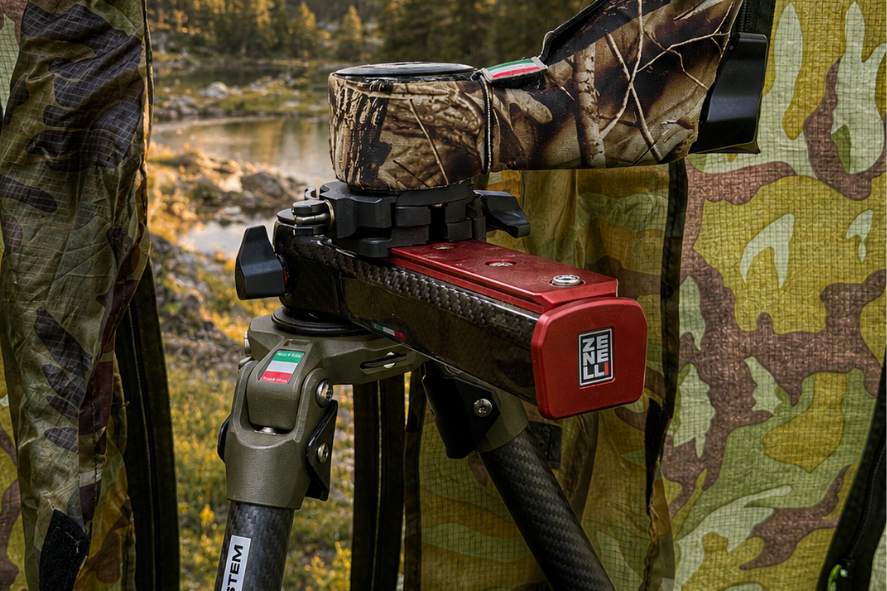
Zenelli tripod systems are designed around rapid leg operation, allowing photographers to extend and secure the telescopic sections efficiently when setting up in the field.
Speed is useful, but repeatability is equally important. The photographer should be able to operate the tripod without having to think about the mechanism every time the shooting position changes.
Consider the Complete Support System
The tripod is only one part of the structure supporting the camera.
The tripod head, mounting interface, lens foot or plate and the camera and lens combination all contribute to the behaviour of the complete system.
For large telephoto lenses, a gimbal head can provide controlled movement and balance, while a ball head offers a more compact and versatile solution for other photographic applications.
The tripod should therefore be chosen together with the type of head and equipment that will normally be mounted on it.
Carbon Fiber Tripods for Wildlife Photography
Zenelli carbon fiber tripods are developed in Italy around the requirements of photographers working with wildlife, birds, sports and long telephoto lenses.
The design approach combines carbon fiber leg structures with precision-machined mechanical components and locking systems developed for repeated outdoor use.
Weight, rigidity, working height, folded dimensions and deployment are considered as parts of the same support system rather than independent specifications.
Different photographers may place different priorities on each of these characteristics, which is why the appropriate tripod depends on the application rather than on a single performance number.
Which Carbon Fiber Tripod Should You Choose?
Before choosing a tripod for wildlife photography, consider how far you normally carry your equipment, the size of the camera and lens combination, the working height you require, the type of tripod head you use and the environments in which you normally photograph.
For long walks, weight and folded dimensions may become priorities.
For large super-telephoto lenses used from relatively fixed positions, structural rigidity may carry greater importance.
For photographers who frequently change locations, deployment speed and portability can become equally relevant.
The best carbon fiber tripod is therefore not defined by one specification.
It is the tripod whose weight, rigidity, height, transport dimensions and operating system best match the equipment you use and the way you actually photograph.