

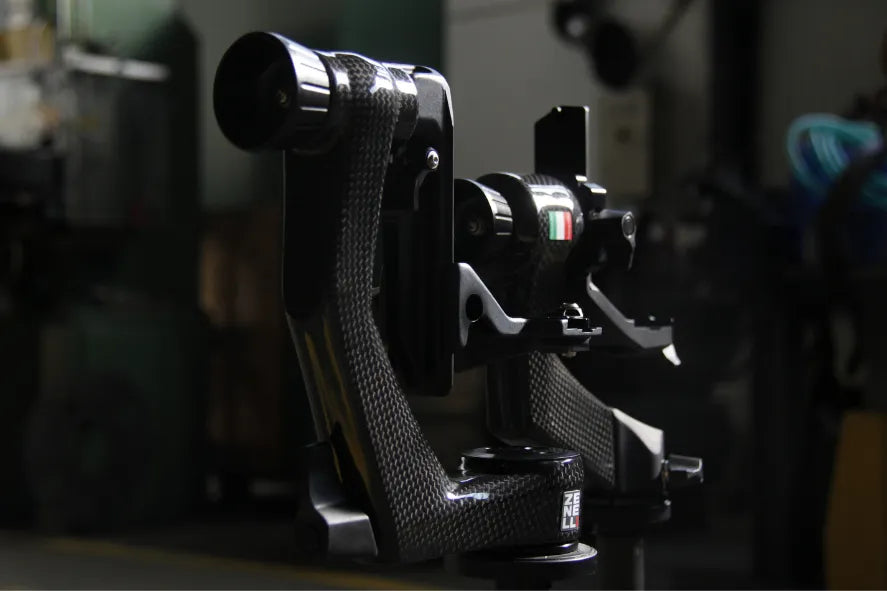
How to Choose the Best Gimbal Head for Wildlife Photography
A gimbal head is one of the most effective support solutions for wildlife photographers using telephoto and super-telephoto lenses.
Unlike a conventional tripod head, a gimbal is designed to position the camera and lens around their center of gravity. When correctly balanced, the equipment remains supported while still allowing controlled pan and tilt movement.
This combination of balance, stability and freedom of movement is particularly useful when following birds, wildlife and other unpredictable subjects.
Choosing the right gimbal head, however, requires more than checking its maximum load capacity.
Start with Your Camera and Lens
The first consideration should be the complete equipment configuration.
A 100–400mm zoom, a 200–600mm zoom and a 600mm prime may reach similar focal lengths, but they can have very different dimensions, weights and center-of-gravity positions.
Camera bodies, teleconverters, battery grips and other accessories can change the balance point further.
The gimbal therefore needs to accommodate the physical characteristics of the complete setup rather than simply the focal length printed on the lens.
Balance Is the Fundamental Requirement
A gimbal works correctly when the camera and lens can be positioned so that their center of gravity is aligned with the tilt axis.
This normally requires two adjustments.
The lens needs to move forward or backward to establish longitudinal balance, while the vertical position of the gimbal platform needs to place the center of gravity at the correct height relative to the tilt axis.
When both adjustments are correct, the lens should remain substantially balanced through its working range without requiring excessive friction to hold it in position.
This is the fundamental principle behind gimbal operation.
Adjustment Range Matters
Maximum load capacity tells you how much weight a head is designed to support, but it does not tell you whether a particular camera and lens can be correctly balanced on it.
A gimbal also needs sufficient adjustment range.
Large prime lenses may require different vertical and longitudinal positions from smaller telephoto zooms.
The lens foot or quick-release plate influences this range as well because its dimensions determine how far the equipment can move within the clamp.
For this reason, load capacity and adjustment range should always be considered together.
Movement Should Be Controlled, Not Simply Free
Wildlife photography requires frequent changes in direction.
A bird can accelerate, change height or reverse direction within seconds. Mammals can move unpredictably through the frame.
The gimbal therefore needs to allow the photographer to pan and tilt without fighting the weight of the equipment.
But completely unrestricted movement is not necessarily the objective.
A well-designed gimbal provides predictable movement that can be controlled according to the subject and equipment being used.
Balance, bearings, friction adjustment and structural rigidity all contribute to this behaviour.
Friction Should Fine-Tune Movement
Friction is useful for changing how the gimbal responds to movement.
It should not be used to compensate for poor balance.
If a lens immediately falls forward or backward when the tilt control is released, adding large amounts of friction may hold it in position, but it does not correct the underlying imbalance.
The correct sequence is to establish mechanical balance first and then use friction to obtain the preferred movement characteristics.
This becomes increasingly important as lens size and weight increase.
Full-Size or Compact Gimbal Head?
Not every wildlife photographer needs the same gimbal architecture.
A full-size gimbal head can provide a wider adjustment range and is particularly appropriate for large super-telephoto lenses and substantial camera configurations.
A compact gimbal head can reduce the size and weight of the support system and may be appropriate for smaller telephoto lenses, telephoto zooms and photographers who prioritize portability.
Neither architecture is automatically better.
The important question is whether the head provides the adjustment range, rigidity and movement required by the equipment being used.
Consider the Weight of the Gimbal Itself
Wildlife photographers often carry their equipment considerable distances.
Camera, lens, tripod, gimbal and accessories all contribute to the total weight of the system.
A lighter gimbal can therefore provide a practical advantage during transport.
Weight reduction, however, should not compromise the structural characteristics required to support and control the equipment.
The objective is not simply to choose the lightest gimbal available, but to find an appropriate relationship between weight, rigidity and adjustment capability.
Carbon Fiber or Aluminum?
Both carbon fiber and aluminum can be used effectively in professional gimbal heads.
Aluminum allows precise machining and can provide excellent structural performance.
Carbon fiber offers high stiffness-to-weight potential and can reduce the mass of selected structural components when the geometry and laminate are designed appropriately.
The material alone does not determine which gimbal will perform better.
Bearings, geometry, interfaces, adjustment mechanisms and overall structural design remain equally important.
A carbon fiber gimbal should therefore be chosen for what the complete design achieves rather than simply because it contains carbon fiber.
Do Not Choose a Gimbal Based on Vibration Claims Alone
Vibration behaviour cannot be attributed to one material or component.
The camera, lens, lens foot, gimbal, tripod, leg extensions, ground conditions and even the photographer's interaction with the equipment contribute to the behaviour of the complete system.
Carbon fiber has different mechanical characteristics from aluminum, but this does not mean that every carbon gimbal automatically provides better vibration performance.
Structural design matters more than a simple material comparison.
The Lens Foot Is Part of the Gimbal System
The connection between the lens and gimbal is sometimes overlooked when choosing a head.
A suitable lens foot or quick-release plate needs to provide enough longitudinal adjustment to establish the correct balance point.
An integrated Arca-Swiss compatible lens foot can provide a direct connection to a compatible gimbal clamp while reducing the need for an additional plate.
For large telephoto equipment, the lens foot, clamp and gimbal should therefore be considered together.
The Tripod Matters Too
Even the most appropriate gimbal cannot compensate for an unsuitable tripod.
The tripod provides the structural foundation for the entire camera system.
Leg diameter, number of sections, working height, locking mechanisms, tripod geometry and ground conditions all influence the behaviour of the equipment above it.
Choosing a gimbal head should therefore be part of a wider support-system decision rather than an isolated purchase.
Which Gimbal Head Is Best for Wildlife Photography?
There is no single gimbal head that is best for every wildlife photographer.
The appropriate choice depends on the camera and lens combination, required adjustment range, type of subjects, amount of movement, desired portability and the tripod being used.
Photographers working primarily with large 400mm, 500mm or 600mm prime lenses may prioritize adjustment range and structural rigidity.
Photographers using lighter telephoto zooms may place greater emphasis on compact dimensions and lower weight.
Bird photographers who frequently track subjects in flight may prioritize freedom and predictability of movement, while photographers working predominantly with stationary subjects may prefer greater resistance and positional control.
Choose the Gimbal Around the Complete System
Maximum load capacity is useful, but it should never be the only specification used to select a gimbal.
The more important question is whether the complete camera and lens combination can be correctly positioned, balanced and controlled on the head.
The best gimbal head for wildlife photography is the one that provides the adjustment range, structural rigidity and controlled movement required to correctly balance your specific camera and telephoto lens while matching the way you actually photograph in the field.

