Carbon Fiber vs Aluminum Gimbal Heads
Choosing between a carbon fiber and an aluminum gimbal head involves more than comparing two materials.
Both can provide the rigidity and precision required to support telephoto lenses, but they achieve this through different material properties and construction methods.
For photographers who carry and operate long telephoto equipment for extended periods, differences in weight, structural design and vibration behaviour can influence how the complete support system feels and performs in the field.
Why Aluminum Is Widely Used in Gimbal Heads
Aluminum has been used for professional photographic equipment for decades.
It combines good mechanical strength with relatively low density and can be CNC machined to precise tolerances. Different aluminum alloys and manufacturing processes also allow designers to optimize components according to their structural function.
These characteristics make aluminum particularly suitable for gimbal components such as arms, pivots, clamps and other precision mechanical interfaces.
A well-designed aluminum gimbal head can therefore provide excellent rigidity, durability and controlled movement.
Its main disadvantage compared with a properly engineered carbon fiber structure is generally weight.
Why Carbon Fiber Is Different
Carbon fiber is a composite material rather than a metal.
Its mechanical properties depend not only on the material itself, but also on fiber orientation, laminate construction, geometry, resin system and manufacturing process.
This gives engineers considerable freedom to develop structures with a high stiffness-to-weight ratio.
For a gimbal head, this can be particularly valuable because reducing the mass of the support system makes the complete camera setup easier to transport without necessarily requiring the same reduction in structural rigidity.
The advantage is therefore not simply that carbon fiber is lighter.
It is the possibility of achieving a different relationship between weight and structural performance.
Weight Matters in the Field
The weight difference between two gimbal heads may appear relatively small when considered on its own.
In wildlife photography, however, the head is only one component of a system that may also include a large telephoto lens, camera body, tripod, accessories and equipment carried in a backpack.
Reducing unnecessary mass from each component can make the complete system easier to transport over long distances.
Weight also matters when equipment is repeatedly moved, packed and repositioned during a day in the field.
For photographers who regularly travel on foot with long-lens equipment, the weight of the gimbal head therefore becomes a practical consideration rather than simply a specification.
Carbon Fiber and Vibration
Carbon fiber and aluminum respond differently to mechanical excitation, but it is important not to reduce this difference to the simple statement that carbon fiber absorbs vibration while aluminum transmits it.
The vibration behaviour of a gimbal head depends on the complete structure.
Material properties, geometry, wall thickness, joints, bearings, interfaces and the camera and lens mounted on the head all contribute to the response of the system.
Composite structures can be engineered to provide useful damping characteristics together with high stiffness and low mass, but the performance of the finished gimbal cannot be predicted from the material name alone.
For photographers, the important consideration is therefore how effectively the complete head controls unwanted movement, not simply whether it is made from carbon fiber or aluminum.
Not All Carbon Fiber Gimbal Heads Are the Same
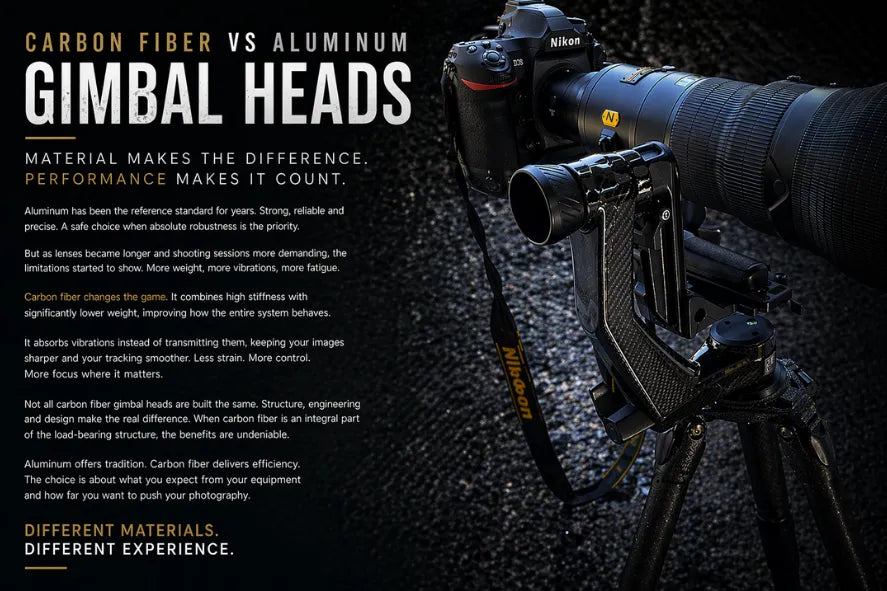
The presence of carbon fiber does not automatically make one gimbal head lighter, stiffer or better controlled than another.
In some products, carbon fiber may be used primarily as a cover or cosmetic element. In others, composite components form part of the load-bearing structure.
This distinction is important.
When carbon fiber is structurally integrated into the design, its geometry and laminate construction can contribute directly to the stiffness and mass of the gimbal.
The appropriate comparison is therefore not simply carbon fiber versus aluminum, but how each material is actually used within the mechanical architecture of the head.
Why Hybrid Construction Can Make Sense
A professional gimbal does not necessarily need to be manufactured entirely from one material.
Carbon fiber is particularly effective where low mass and structural efficiency are priorities, while aluminum and other metallic alloys remain highly suitable for components requiring precise machined interfaces, threads, bearing seats and concentrated load transfer.
Combining different materials allows each component to be developed according to its mechanical function.
This hybrid approach can provide a more effective solution than selecting one material for every part of the gimbal simply for consistency.
Carbon Fiber or Aluminum for Long Telephoto Lenses?
Both carbon fiber and aluminum gimbal heads can be suitable for telephoto and super-telephoto photography when correctly designed for the equipment being used.
An aluminum gimbal can be an appropriate choice when additional weight is not an important limitation and the photographer values a conventional all-metal construction.
A structurally engineered carbon fiber gimbal becomes particularly interesting when reducing the weight of the support system is a priority, especially for photographers who frequently carry their equipment over long distances.
The decision should therefore consider more than the material.
Adjustment range, balance, rigidity, movement, compatibility, total weight and the mechanical design of the complete head are all relevant.
The Zenelli Approach
Zenelli carbon fiber gimbal heads use composite structures together with precision-machined metallic components.
Carbon fiber is used as a structural material rather than simply as a decorative external layer, while metallic components are used where their mechanical properties and machining precision are appropriate for the function.
The objective is to use each material where it provides a practical engineering advantage within the complete gimbal architecture.
This approach allows weight, rigidity, adjustment and mechanical precision to be considered together rather than treating the choice of material as an isolated specification.
The Material Is Only Part of the Design
Carbon fiber and aluminum both have characteristics that make them valuable in professional photographic equipment.
Aluminum provides precise machinability, strength and proven durability. Carbon fiber provides the opportunity to achieve high structural efficiency at relatively low mass.
The important difference is not simply what material appears on the specification sheet, but how that material is engineered into the product.
A carbon fiber gimbal head should therefore be evaluated not because it contains carbon fiber, but because of what its complete structural design achieves in terms of weight, rigidity, control and practical use in the field.