Why Sharp Images with Super-Telephoto Lenses Are Not Just About Shutter Speed
When photographing wildlife with a 400mm, 500mm, 600mm or 800mm lens, achieving consistently sharp images can be more challenging than it first appears.
A common solution is to use a faster shutter speed. In many situations this works, but shutter speed is only one part of the equation. With long and super-telephoto lenses, even very small movements of the camera and lens can become significant. Wind, ground conditions, photographer technique, lens balance and the rigidity of the support system can all influence the final image.
Understanding these factors can help wildlife photographers improve image sharpness and, just as importantly, understand when increasing shutter speed alone may not solve the problem.
Small Movements Matter
The longer the focal length, the narrower the angle of view. This means that even a very small angular movement of the camera can translate into noticeable movement of the subject within the frame.
At shorter focal lengths, the same movement may barely be visible. With a 600mm or 800mm lens aimed at a distant subject, however, small vibrations or changes in camera position become much more apparent.
This is why working with large telephoto lenses requires more than simply supporting their weight. The objective is to create a stable and controlled platform for the entire camera and lens system.
A fast shutter speed helps freeze subject movement and reduces the visible effects of camera movement during the exposure. It is essential for birds in flight, running animals and many other dynamic situations. But subject movement and equipment movement are two different problems.
Increasing shutter speed does not make the camera system itself more stable. Movement can still affect composition, autofocus tracking and the photographer's ability to keep a small or distant subject precisely positioned in the frame.
The Whole System Matters
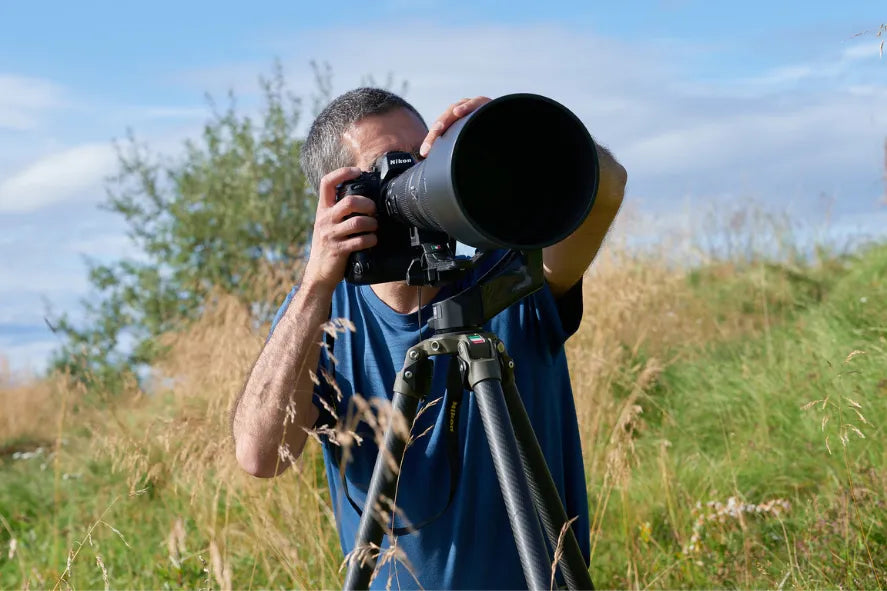
A stable wildlife photography setup should be considered as a complete system. The camera, lens collar, quick-release plate, head, tripod or monopod and even the surface beneath the photographer all contribute to its behaviour.
A weak point anywhere in this chain can introduce movement. This is also why the maximum load capacity printed in the specifications of a tripod or head should not be interpreted as a direct measurement of photographic stability.
Supporting the static weight of a camera and lens is relatively simple. Controlling vibration, flex and rotational movement is considerably more complex. With large super-telephoto lenses, torsional rigidity and the control of small movements can be just as important as vertical load capacity.
Wind is another factor that is easy to underestimate. A large telephoto lens presents a considerable surface area, and the lens hood can behave almost like a small sail. Even when the tripod appears stationary, wind can generate small oscillations through the lens and support system.
Lowering the tripod and avoiding unnecessary extension of the legs can improve rigidity in difficult conditions. The photographer's technique also matters. A light and controlled hand can sometimes help manage movement, while excessive pressure on the camera or lens may introduce additional vibration.
Don't Forget the Ground
Tripod stability does not end at the tripod feet. Soft soil, sand, mud, snow, vegetation and wooden observation platforms all behave differently under load.
A perfectly rigid tripod standing on an unstable surface is still an unstable photographic platform.
Wooden hides and observation decks are a good example. Another photographer walking nearby can create vibrations that travel through the structure and reach the camera. On soft terrain, tripod feet may slowly sink or move even when everything initially appears stable.
Sometimes improving image sharpness therefore has nothing to do with changing a camera setting or using heavier equipment. Simply changing the position of the tripod or finding firmer ground can make a noticeable difference.
Balance and Control
Correctly balancing a super-telephoto lens is particularly important when using a gimbal head. When the camera and lens are properly balanced around the rotation axis, the system requires less force to move and remains much more neutral when the photographer releases it.
Poor balance creates a constant rotational force. The photographer then has to compensate while tracking the subject, making precise movements more difficult.
A properly balanced gimbal does not simply make a heavy lens feel lighter. It improves the control and predictability of the entire camera system, which becomes particularly important when following birds or rapidly moving wildlife.
Modern optical and in-body image stabilization systems can also be extremely effective, allowing photographers to work at shutter speeds that would once have been very difficult. However, image stabilization and physical support perform different functions.
Stabilization compensates for certain types of detected movement, while a tripod, monopod or other support physically controls the position and movement of the equipment. They should therefore not automatically be considered alternatives. Stabilization behaviour can also vary when equipment is tripod-mounted, so the manufacturer's recommendations for the specific camera and lens combination should always be considered.
Choosing the Right Support
There is no single support solution that is best for every wildlife photographer.
Handheld shooting provides maximum freedom and extremely fast reactions, particularly with lighter telephoto lenses. A monopod reduces the weight carried by the photographer while maintaining excellent mobility and can be particularly useful when positions change frequently.
A tripod combined with a gimbal head provides a more controlled platform for large super-telephoto lenses and is especially useful when working from a relatively fixed position or waiting for wildlife for extended periods.
The right choice depends on the lens, the subject, the environment and the photographer's way of working. Stability is important, but it should not prevent the photographer from following the subject naturally.
Before assuming that a faster shutter speed is the only way to obtain sharper images, it is worth observing the complete setup. Check the balance of the lens, avoid extending the tripod more than necessary, pay attention to wind and terrain, make sure the feet are firmly positioned and avoid unnecessary pressure on the camera during the exposure.
Even the viewfinder can provide useful information. If a stationary subject appears to move slightly within the frame while the camera should be still, something in the system or in the surrounding environment is probably moving. Identifying that source can often be more useful than simply increasing the shutter speed again.
Stability Means Control
A professional support system should do more than simply carry the weight of a camera and lens. With long and super-telephoto lenses, the objective is to create a predictable connection between the photographer, the equipment and the subject.
Rigidity, balance, smooth movement and good field technique all contribute to that result.
At Zenelli, these principles influence the development of our carbon fiber tripods, monopods and gimbal heads for wildlife photography. Materials, components and geometries are engineered not simply around maximum load figures, but around the behaviour of the complete support system when used with long and super-telephoto lenses in real field conditions.
Because with a 600mm or 800mm lens, even the smallest movements can matter. Consistently sharp wildlife images begin long before the shutter is released.