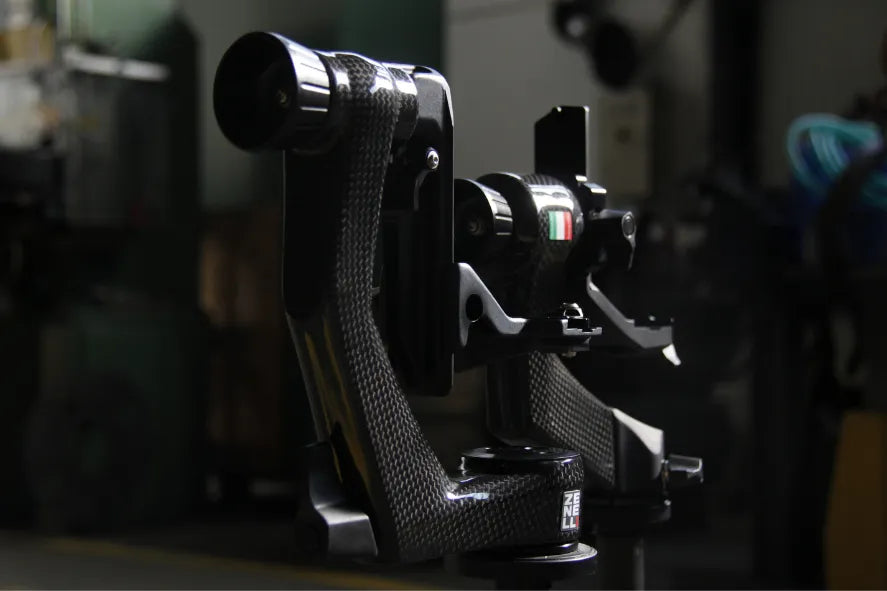
Carbon TS: Built for Competitive Precision Shooting
There is a moment, in a precision shooting stage, when everything slows down.
You are on the clock, the position is not perfect, the target is small and far. In that moment, stability is not just important. It is everything. A slight movement, a vibration, a delayed adjustment, and the shot is gone.
This is the environment the Carbon TS was designed for.
In disciplines like NRL and PRS, equipment is constantly pushed to its limits. Shooters move quickly between positions, adapt to uneven terrain, and manage heavy rifle setups under pressure. The tripod is not just support. It becomes part of the shooting system.
Carbon fiber plays a central role in how the system behaves. It is not simply a matter of reducing weight. It changes the way energy is handled. Recoil is absorbed more quickly, vibrations dissipate faster, and the structure maintains its rigidity even under load.
Compared to traditional aluminum designs, the difference becomes clear over time. The system feels more stable, more controlled, more predictable. Small movements are reduced, and follow-up shots become more consistent.
With modern competition setups, rifles are often equipped with optics, weights, and accessories that increase overall mass. Managing this weight requires a structure that does not flex, does not shift, and does not introduce uncertainty. The Carbon TS is designed to provide that level of confidence, maintaining stability even in demanding configurations.
But stability alone is not enough.
Speed matters just as much.
In a timed stage, the ability to deploy quickly and move efficiently between positions can define the outcome. The tripod must adapt instantly, without hesitation. Leg adjustments must be intuitive, locking mechanisms reliable, and the structure must remain solid even when the environment is far from ideal.
Dust, sand, uneven ground. These are not exceptions. They are part of the process.
In this context, weight also becomes a factor. Between stages, shooters carry everything. Reducing fatigue without sacrificing rigidity allows for better focus and more consistent performance over time. A lighter system does not just improve comfort. It improves clarity under pressure.
What ultimately defines a competition tripod is not a single feature, but how it behaves when everything is happening at once. The way it absorbs movement, the way it holds position, the way it responds when time is limited and precision is absolute.
Because in precision shooting, accuracy is not only about the rifle. It is about everything that supports it.
And that support must be as consistent as the shot itself.