Carbon Fiber & Craftsmanship: The Art of Autoclave Technology
Carbon fiber is often described through its performance.
Lightweight. Strong. Precise.
But these qualities do not exist on their own. They are the result of a process. A process that, when approached correctly, is as much about craftsmanship as it is about engineering.
At first glance, carbon fiber can feel like a purely technical material. In reality, it is one of the most sensitive composites to work with. Its behavior depends on how it is handled, how it is layered, and how it is cured. Every step influences the final result.
This is where autoclave technology becomes essential.
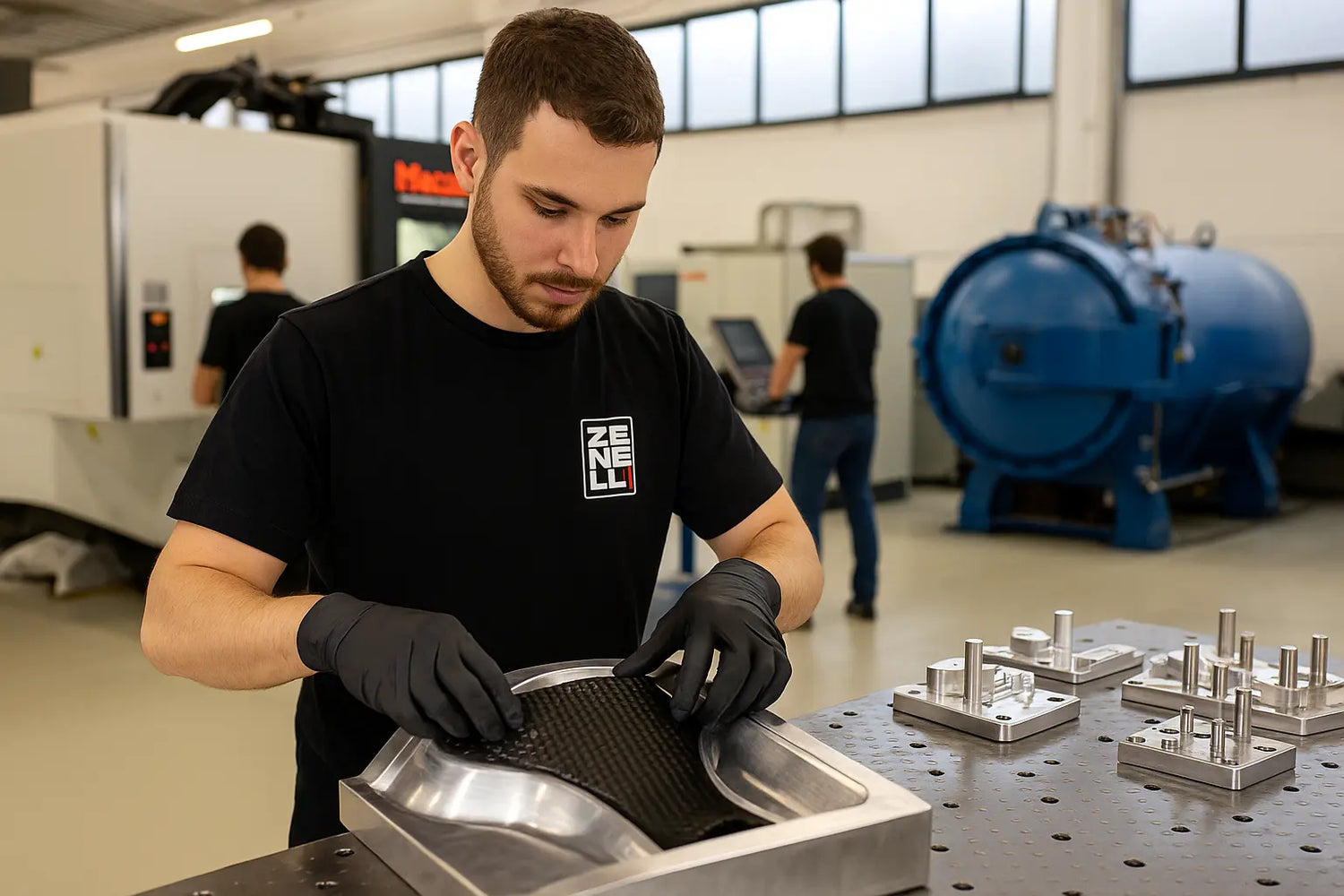
Unlike industrial processes designed for speed, autoclave curing is based on control. Pre-impregnated carbon fibers are laid by hand, layer after layer, and then cured inside a high-pressure environment where temperature and pressure are precisely managed. The goal is not just to shape the material, but to define its internal structure.
The result is a component with exceptional consistency.
The fibers bond without voids, the resin cures uniformly, and the structure achieves a level of integrity that cannot be replicated with simpler processes. What emerges is not only lighter, but also more stable and more predictable under load.
Yet the autoclave itself is only part of the story.
What truly defines the outcome is everything that happens before it.
Each layer must be positioned with intention. Fiber orientation is not random, but chosen to manage how forces travel through the structure. Cutting, placing, and aligning the material requires experience, not automation. A small deviation at this stage can influence stiffness, vibration behavior, and long-term reliability.
Working with carbon fiber in this way is not about repetition.
It is about understanding.
Understanding how the material reacts under pressure.
How it changes during curing.
How it will perform once it becomes part of a real system.
This approach naturally leads to a different way of producing components.
Instead of large-scale uniformity, the focus shifts toward small-batch production, where each part is refined, controlled, and evaluated. This allows for more precise geometries, better optimization, and solutions that are not limited by standard industrial constraints.
In high-performance photography equipment, this level of control becomes critical.
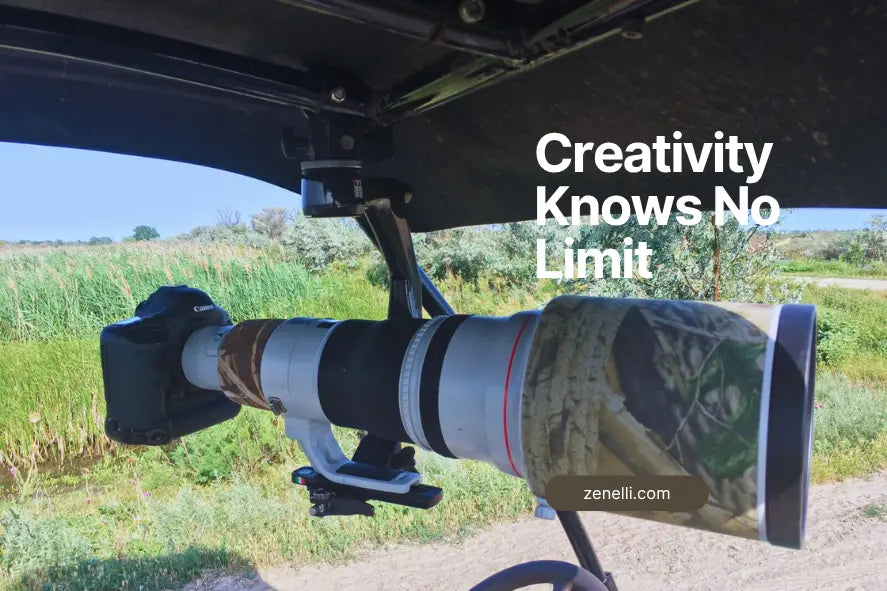
When working with long telephoto lenses, every gram influences balance, and every vibration affects image precision. A structure that is both light and rigid, without internal inconsistencies, directly improves the shooting experience.
What defines these components is not only the material, but the process behind them.
A combination of advanced technology and manual expertise.
A balance between engineering precision and human control.
A result shaped as much by knowledge as by tools.
Because with carbon fiber, performance is not simply manufactured.
It is built, layer by layer.