Why Sharp Images with Super-Telephoto Lenses Are Not Just About Shutter Speed
When photographing wildlife with a 400mm, 500mm, 600mm or 800mm lens, achieving consistently sharp images can be more challenging than simply selecting a fast shutter speed.
Shutter speed is essential for controlling subject movement and reducing the visible effects of camera movement during the exposure. But with long and super-telephoto lenses, image sharpness also depends on what happens to the complete camera and support system before and during the exposure.
Small vibrations, wind, ground conditions, lens balance, photographer technique and the rigidity of the support can all influence the result.
Understanding the difference between these factors helps explain why increasing shutter speed alone does not always solve a sharpness problem.
Why Small Movements Matter More with Long Lenses
The longer the focal length, the narrower the angle of view. As a result, even a very small angular movement of the camera can produce noticeable movement of the subject within the frame.
At shorter focal lengths, the same movement may barely be visible. With a 600mm or 800mm lens aimed at a distant subject, small vibrations or changes in camera position become much more apparent.
This is why supporting a super-telephoto lens involves more than simply carrying its weight. The objective is to create a stable and controllable platform for the entire camera and lens system.
A fast shutter speed can reduce the visible effect of camera movement during the actual exposure, but it does not make the camera system itself more stable.
Movement can still affect framing, autofocus tracking and the photographer's ability to keep a small or distant subject precisely positioned.
Subject Movement and Equipment Movement Are Different Problems
When a bird is flying or an animal is running, shutter speed is primarily used to control motion blur caused by the subject.
Movement of the camera and lens is a different problem.
Even when the exposure is fast enough to freeze the subject, an unstable support system can make it more difficult to maintain accurate framing and keep the autofocus point where it needs to be.
For this reason, shutter speed and mechanical stability should not be considered interchangeable solutions.
One controls what happens during the exposure. The other helps control the physical position and behaviour of the equipment.
The Whole Support System Matters
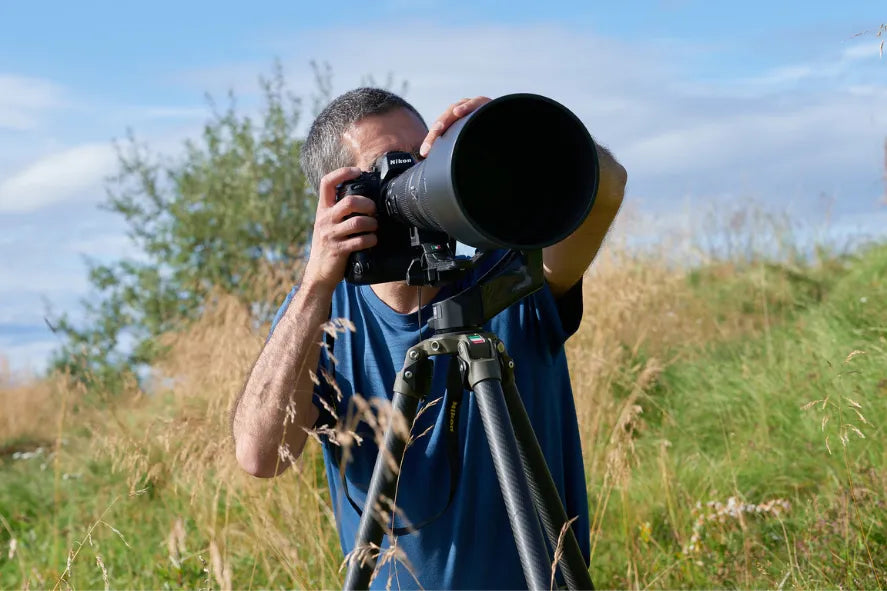
A wildlife photography setup should be considered as a complete mechanical system.
The camera, lens collar, lens foot or quick-release plate, head, tripod or monopod and the surface beneath the support all contribute to its behaviour.
A weak point anywhere in this chain can introduce movement.
This is also why the maximum load capacity printed in the specifications of a tripod or head should not be interpreted as a direct measurement of photographic stability.
Supporting the static weight of a camera and lens is relatively simple. Controlling flex, vibration and rotational movement is more complex.
With large super-telephoto lenses, torsional rigidity and resistance to small unwanted movements can therefore be just as important as vertical load capacity.
Wind Can Affect a Super-Telephoto Setup
Wind is particularly important with large lenses because the lens body and hood present a considerable surface area.
The hood can effectively act as a lever through which wind introduces movement into the camera and support system.
The tripod may appear stationary while small oscillations are still occurring at the camera or front of the lens.
Lowering the tripod and avoiding unnecessary leg extension can increase rigidity in difficult conditions. Photographer technique also matters. Excessive pressure on the camera or lens can introduce movement into a system that would otherwise remain stable.
The Ground Is Part of the Support System
Tripod stability does not end at the tripod feet.
Soft soil, sand, mud, snow, vegetation and wooden observation platforms all behave differently under load.
A rigid tripod standing on an unstable surface is still an unstable photographic platform.
Wooden hides and observation decks are a good example. Another photographer walking nearby can introduce vibrations into the structure that travel through the tripod and reach the camera.
On soft terrain, tripod feet can also slowly sink or change position even when the setup initially appears stable.
Sometimes improving image sharpness therefore has nothing to do with changing a camera setting or using heavier equipment. Moving the tripod to firmer ground can be enough to change the behaviour of the complete system.
Balance Improves Control
Correct balance becomes particularly important when a super-telephoto lens is mounted on a gimbal head.
When the camera and lens are balanced around the rotation axis, less force is required to control their movement. Poor balance creates a rotational force that the photographer must continuously compensate for while tracking.
The primary benefit is therefore not simply that a heavy lens feels lighter.
Correct balance makes the movement of the camera system more predictable and easier to control.
This becomes especially useful when following birds or other wildlife whose direction can change rapidly.
Image Stabilization and Physical Support Do Different Jobs
Modern optical and in-body image stabilization systems can be extremely effective, but stabilization and physical support should not automatically be considered alternatives.
Image stabilization attempts to compensate for certain detected movements. A tripod, monopod or other support physically controls the position and movement of the camera and lens.
The two systems therefore address different aspects of camera movement and can work together depending on the equipment being used.
Stabilization behaviour can vary when a camera or lens is mounted on a tripod, so photographers should always follow the manufacturer's recommendations for their specific camera and lens combination.
Tripod, Monopod or Handheld?
There is no single support solution that is best for every wildlife situation.
Handheld shooting provides maximum freedom and rapid reaction, particularly with lighter telephoto lenses.
A monopod transfers much of the equipment's weight away from the photographer while maintaining a high degree of mobility, making it useful when shooting positions change frequently.
A tripod provides a more stable physical platform and, when combined with a gimbal head, can offer controlled movement for large super-telephoto lenses. This can be particularly useful when working from a relatively fixed position or waiting for wildlife for extended periods.
The appropriate solution therefore depends on the lens, subject, environment and shooting style.
How to Identify Movement in the Field
Before assuming that a faster shutter speed is the only solution to a sharpness problem, observe what the complete setup is doing.
The viewfinder itself can provide useful information.
If a stationary subject appears to move slightly within the frame while the camera should be still, movement is entering the system somewhere.
It may originate from wind, the tripod, the ground, the head, the photographer's hands or another part of the camera and lens assembly.
Identifying the source of that movement can often be more useful than simply increasing the shutter speed again.
Stability Means Control
With long and super-telephoto lenses, stability is not simply the ability of a support system to carry a certain weight.
It is the ability to control unwanted movement while still allowing the photographer to move the camera naturally when required.
Rigidity, balance, terrain, wind, support geometry and photographer technique all contribute to that behaviour.
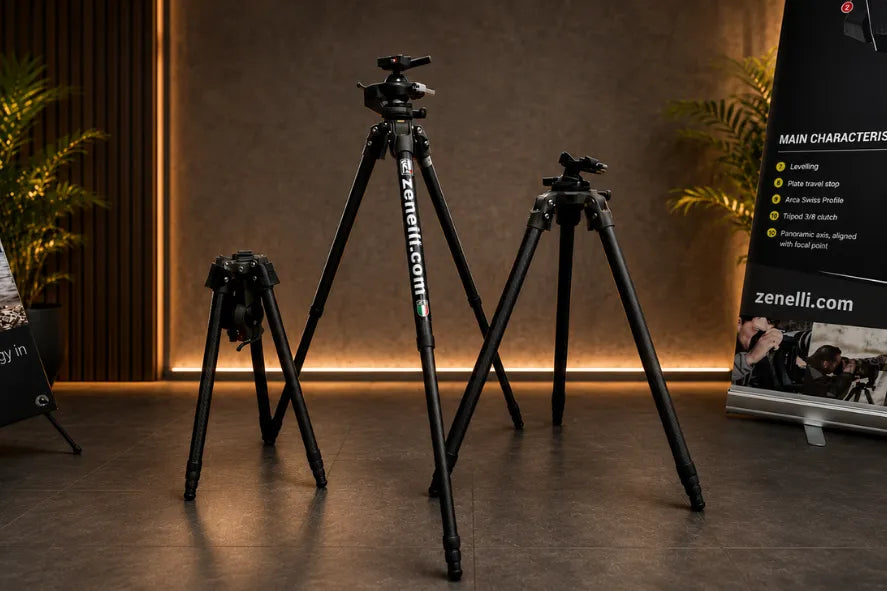
At Zenelli, these principles influence the development of our carbon fiber tripods, monopods and gimbal heads for wildlife photography. Materials, components and geometries are engineered not simply around maximum load figures, but around the behaviour of the complete support system with long and super-telephoto lenses in real field conditions.
With a 600mm or 800mm lens, even very small movements can become visible. A fast shutter speed can help freeze an image, but consistently sharp super-telephoto photography also depends on controlling the camera system itself.