Zenelli® Tripods: Designed for Wildlife and Outdoor Photography
A tripod used for wildlife and outdoor photography has to do more than support the weight of a camera.
It needs to provide a stable platform for telephoto equipment while remaining practical to carry, quick to deploy and reliable in environments where dust, moisture, uneven terrain and repeated movement are part of normal use.
Zenelli® tripods are designed around this combination of stability, portability and field operation.
The objective is not to optimize a single specification, but to create a support system in which the legs, locking mechanisms, materials and overall geometry work together.
Designed Around Real Field Use
Wildlife photographers rarely work in controlled conditions.
Equipment may be transported over long distances, repeatedly opened and closed, positioned on irregular ground and exposed to dust, vegetation and changing weather.
These conditions influence the design of a professional tripod.
Weight matters when the equipment needs to be carried. Rigidity matters when a long telephoto lens is mounted. Deployment speed matters when the subject moves. Reliability matters when the tripod is used repeatedly away from the studio.
A field tripod therefore needs to balance requirements that often work against each other.
180° Reverse-Folding Legs
One of the distinctive characteristics of Zenelli tripod design is the ability of the legs to fold through 180 degrees.
In this configuration, the legs can fold back around the upper part of the tripod, reducing the overall dimensions of the system for transport.
This approach allows the support system to occupy less space when packed while maintaining the working geometry required when the tripod is deployed.
For photographers travelling with a telephoto lens, camera body and other field equipment, transport dimensions can be just as important as working height.
Telescopic Legs Designed for Repeated Operation
A tripod leg is not simply a carbon fiber tube.
It is a telescopic mechanical system in which multiple sections, guides, locking components and interfaces need to operate together.
The movement between sections needs to remain controlled while providing sufficient rigidity once the leg is locked.
Zenelli develops its telescopic leg systems around repeated field operation, with internal components designed to guide and lock the individual sections while keeping the external architecture compact.
Protection from Outdoor Contamination
Dust, sand and moisture are unavoidable in many outdoor environments.
Zenelli tripod legs incorporate sealing elements intended to reduce the entry of external contamination into the telescopic mechanism during normal field use.
The system is designed to provide additional protection to the internal components, but it should not be considered hermetically sealed or intended for prolonged immersion.
After significant exposure to water, sand, salt or mud, appropriate cleaning and drying remain important for maintaining the equipment over time.
Internal Locking System
The locking mechanism is integrated into the tripod leg structure rather than relying on large external mechanisms.
This creates a compact external profile and keeps much of the mechanical system protected inside the leg assembly.
The objective is to make extension and locking straightforward while maintaining a clean structure that is practical to handle during transport and field use.
The locking system is therefore not an isolated feature. It is part of the structural chain that determines how the different telescopic sections behave once the tripod is deployed.
Carbon Fiber, Aluminum and Magnesium
Different parts of a tripod perform different mechanical functions, which is why a single material is not necessarily appropriate for every component.
Carbon fiber is used where its stiffness-to-weight characteristics can benefit the leg structure.
Aluminum and magnesium alloys are used in selected mechanical and structural components where geometry, precision machining, strength and low mass need to be considered together.
The objective is not simply to minimize weight.
It is to place the appropriate material where it contributes most effectively to the complete tripod.
Stability for Telephoto Equipment
Long telephoto and super-telephoto lenses place particular demands on a support system.
Small movements at the tripod can become increasingly relevant as focal length increases, while the mass and dimensions of the camera and lens create loads that must be managed by the complete structure.
Tripod stability therefore cannot be described by maximum load capacity alone.
Leg diameter, tube construction, number of sections, tripod geometry, locking mechanisms, working height and the connection to the tripod head all contribute to the behaviour of the complete system.
This is why Zenelli approaches the tripod as a mechanical system rather than as a set of independent specifications.
Compactness Without Ignoring Rigidity
A tripod that folds into a small package is useful only if it still provides the required support when deployed.
Conversely, an extremely rigid structure has limited value in wildlife photography if its weight and dimensions make it impractical to carry to the shooting location.
The engineering challenge is to manage both requirements.
Zenelli tripod architecture is developed around this relationship between transport dimensions, working height, structural rigidity and total weight.
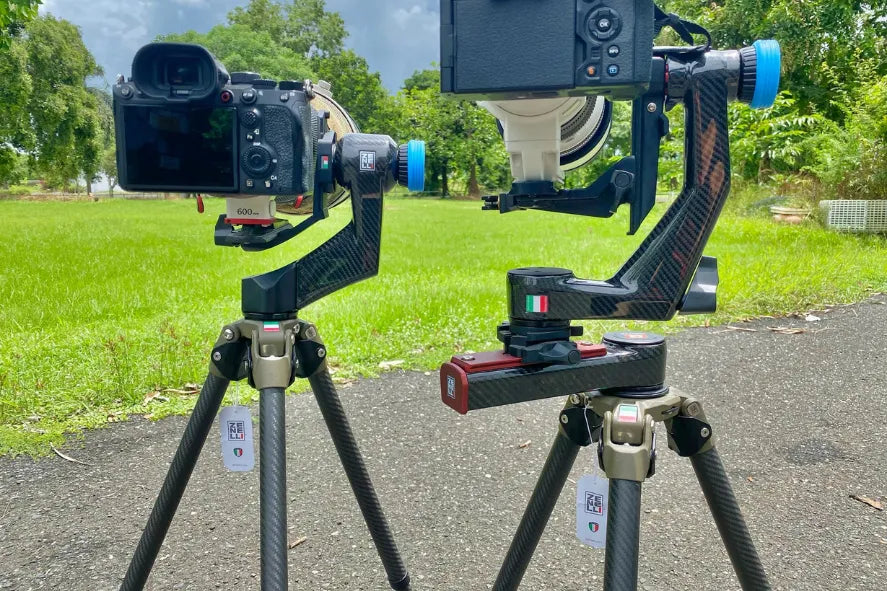
Designed to Work with Gimbal Heads
For wildlife photographers using large telephoto lenses, the tripod is only one part of the support system.
The gimbal head, lens foot and mounting interfaces all contribute to how the equipment behaves.
A correctly balanced gimbal reduces the effort required to move a large lens, while the tripod underneath provides the structural foundation for the complete assembly.
Considering these components together creates a support system designed around both stability and controlled movement.
Coyote Finish for Natural Environments
Selected Zenelli tripod configurations are available with the Coyote finish, an earth-toned surface developed for photographers who prefer equipment with lower visual contrast in natural environments.
The finish does not change the fundamental mechanical function of the tripod.
It provides an alternative visual configuration for wildlife and outdoor photographers who prefer their support equipment to integrate more discreetly with the surroundings.
A Tripod Is a Complete Mechanical System
No single specification defines how a tripod will perform in the field.
Maximum load, weight, tube diameter or folded length can each provide useful information, but none describes the complete system by itself.
The interaction between structure, materials, leg geometry, locking mechanisms, working height and support head ultimately determines how practical the tripod is to carry and how it behaves when deployed.
Zenelli tripods are designed as complete support systems for photographers who need to combine portability, structural rigidity and controlled operation in real outdoor environments.