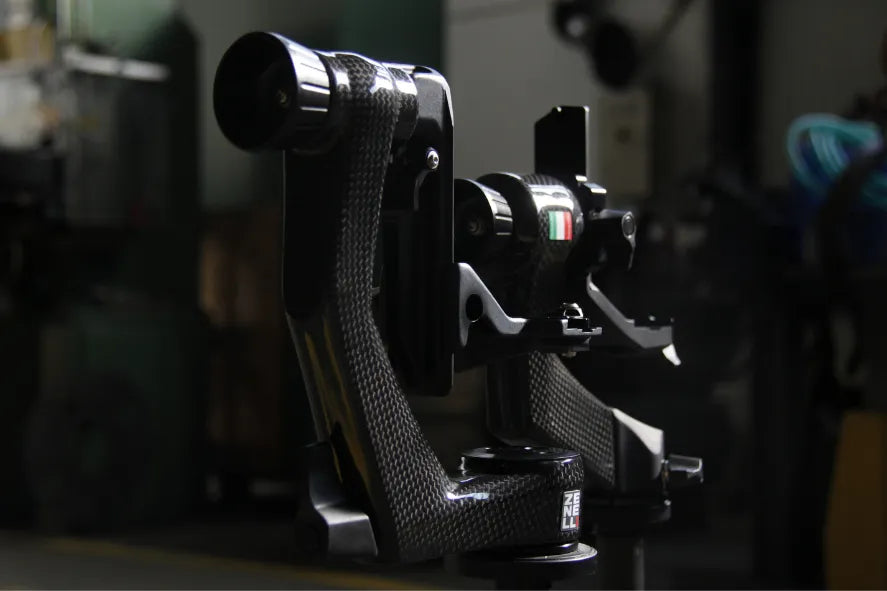
Best Gimbal Head for a 600mm Lens
There is a point, when working with a 600mm lens, where the limits are no longer optical. They are mechanical.
A super telephoto of this size opens extraordinary possibilities. It allows you to isolate distant subjects, capture wildlife without intrusion, and compress scenes in a way no other lens can. But it also introduces a new reality. Weight, inertia, and balance become part of every shot.
Without the right support, even the best 600mm lens becomes difficult to manage. Movements feel forced, tracking becomes inconsistent, and fatigue builds quickly. Over time, precision suffers.
This is why choosing the right gimbal head is not optional. It is part of the system.
A properly balanced gimbal head allows the camera and lens to rotate around their center of gravity, transforming a heavy setup into something fluid and controlled. Instead of resisting movement, the system responds to it. The lens feels lighter, more predictable, easier to guide.
In wildlife photography, this changes everything.
Following a bird in flight, adjusting framing on a moving subject, or holding position while waiting for the right moment all require smooth, continuous motion. A well-designed gimbal head allows this to happen naturally, without effort.
The difference becomes even more evident during long sessions. A 600mm setup can easily exceed five kilograms when combined with a professional camera body. Managing that weight without proper balance leads to strain and reduced accuracy. With a gimbal head, the load is distributed correctly, allowing the photographer to stay focused and reactive for longer periods.
Not all gimbal heads, however, are suited for this level of demand.
With large super-telephoto lenses, structural rigidity becomes critical. Any flex, even minimal, can affect tracking precision and image stability. Smoothness of movement is equally important. The transition between horizontal and vertical motion must feel continuous, without friction or hesitation.
Material also plays a key role. Traditional aluminum heads provide strength, but they add weight and tend to transmit vibration. Carbon fiber introduces a different behavior. It combines stiffness with reduced mass and natural vibration damping, helping to stabilize the system and improve control, especially in outdoor environments.
When properly engineered, a carbon fiber gimbal head allows photographers to reduce overall weight without compromising rigidity. This becomes particularly important when working in the field, where mobility and endurance are as important as stability.
For photographers using a 600mm lens, the priority is clear. The support system must handle the load with confidence, maintain precise balance, and allow fluid movement in every direction. Anything less becomes a limitation.
Within this context, full-size gimbal heads are typically the most effective solution. Designs that prioritize rigidity and balance adjustment offer the level of control required for large telephoto lenses. More compact models can still be useful with lighter setups or zoom lenses, but when working consistently at 600mm, stability remains the defining factor.
What ultimately matters is not just the specification of the gimbal head, but how it behaves in use. The way it supports the lens, the way it responds to movement, the way it disappears once you are focused on the subject.
Because at this level, the goal is not simply to support the equipment. It is to allow it to perform at its full potential.