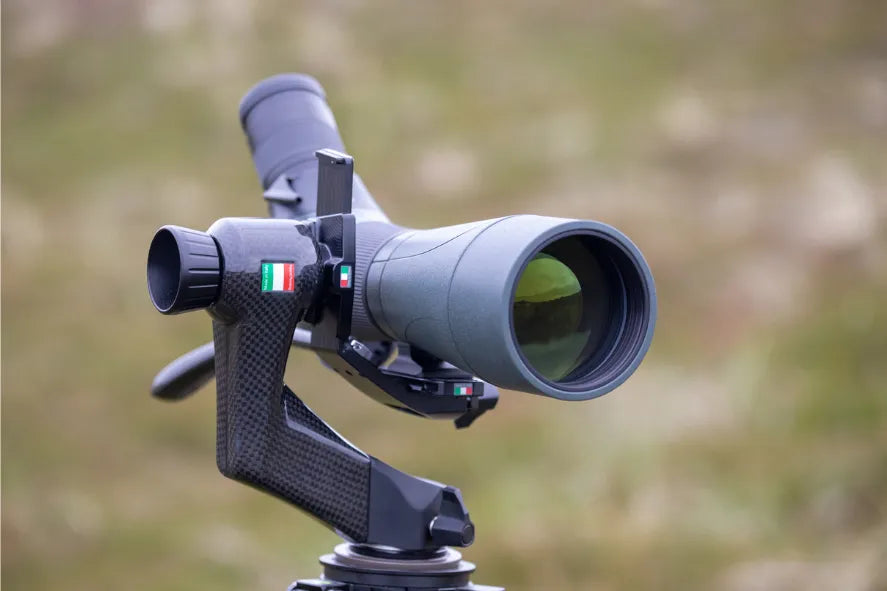
Best Gimbal Head for a 600mm Lens
A 600mm lens places very different demands on a support system compared with smaller telephoto equipment.
The challenge is not simply the weight of the lens. Its physical length, balance point and inertia all influence how easily the camera can be moved, stopped and repositioned.
For wildlife and bird photography, where subjects can change direction without warning, the tripod head must support the equipment while still allowing controlled movement.
This is where a gimbal head becomes particularly useful.
Why Use a Gimbal Head with a 600mm Lens?
A gimbal head is designed to position a telephoto lens around its center of gravity.
When the camera and lens are correctly balanced, much of the effort normally required to hold and reposition a large lens is transferred to the support system.
The photographer can then guide the lens through pan and tilt movements rather than continuously supporting its weight.
With a 600mm lens, this can make a substantial difference during long wildlife sessions or when repeatedly tracking moving subjects.
Balance Is More Important Than Maximum Load
Maximum load capacity is useful information, but it does not determine whether a gimbal is appropriate for a particular 600mm setup.
A head may be capable of supporting the total weight of the camera and lens while still lacking the adjustment range required to position their center of gravity correctly.
The complete setup must be considered.
The lens foot or quick-release plate needs sufficient longitudinal adjustment to move the equipment forward and backward, while the gimbal geometry must allow the lens to be positioned correctly relative to the tilt axis.
A gimbal for a 600mm lens should therefore be selected according to both load capacity and balance adjustment range.
Why Adjustment Range Matters
Different 600mm lenses can have very different dimensions and balance points.
A 600mm prime lens paired with a professional camera body creates a different mechanical configuration from a 200–600mm zoom or a smaller lens used with a teleconverter.
Accessories can change the balance point as well.
Changing the camera body, adding a battery grip, using a teleconverter or attaching other equipment alters the distribution of mass within the system.
A suitable gimbal must provide enough adjustment to compensate for these differences.
Tracking Wildlife with a 600mm Lens
At 600mm, the field of view is narrow.
This makes precise camera movement particularly important when following birds, mammals or other moving subjects.
The gimbal needs to allow smooth horizontal panning and controlled vertical movement without forcing the photographer to fight against the weight of the equipment.
Correct balance reduces the effort required to initiate movement and makes it easier to stop or change direction predictably.
The objective is not to make a large lens physically weightless.
It is to make its movement easier to control.
Friction and Movement
Once the lens is balanced, friction can be adjusted according to the subject and the photographer's preference.
Fast-moving wildlife may benefit from relatively free movement, while slower subjects can allow slightly more resistance.
The important characteristic is predictability.
The head should move when the photographer applies force and stop without requiring unnecessary correction.
With a long lens, excessive resistance can make tracking difficult, while an excessively loose setup can make precise positioning harder.
Balance should therefore be established before using friction to control movement.
Rigidity Matters with Large Telephoto Lenses
A 600mm lens creates leverage because its mass extends away from the support structure.
For this reason, the mechanical rigidity of the gimbal becomes particularly important.
The head, bearings, adjustment mechanisms, lens foot and quick-release interface all contribute to the behaviour of the complete system.
A high maximum load rating does not automatically guarantee high rigidity.
For large super-telephoto equipment, the structural design of the complete gimbal should be considered together with its specified load capacity.
Full-Size or Compact Gimbal for a 600mm Lens?
A full-size gimbal is often a practical solution for large 600mm prime lenses because its architecture can provide the adjustment range and structural dimensions required by substantial telephoto equipment.
A compact gimbal can also work with some 600mm configurations when the dimensions, weight and center of gravity of the specific camera and lens combination fall within its adjustment range.
Focal length alone therefore does not determine the required gimbal size.
The physical characteristics of the complete setup are more important.
A 600mm prime and a zoom lens reaching 600mm should not automatically be treated as mechanically equivalent simply because they share the same maximum focal length.
Carbon Fiber or Aluminum?
Both carbon fiber and aluminum can be used effectively in professional gimbal construction.
Aluminum provides strength, precise machinability and durable mechanical interfaces.
Carbon fiber can provide a high stiffness-to-weight ratio when it is used as part of the load-bearing structure rather than simply as a cosmetic element.
For photographers carrying a 600mm system over long distances, reducing the mass of the gimbal can contribute to a lighter overall equipment package.
The material, however, should never be considered independently from the geometry and mechanical design of the head.
The Lens Foot and Plate Are Part of the System
The interface between the lens and gimbal is particularly important with large telephoto equipment.
An appropriate lens foot or quick-release plate must provide secure attachment while also allowing sufficient longitudinal movement for balancing.
If the plate is too short, the photographer may be unable to reach the correct balance point even when the gimbal itself provides adequate adjustment.
Arca-Swiss compatible interfaces are widely used for this purpose because they allow the lens position to be adjusted along the clamp before it is secured.
When choosing a gimbal for a 600mm lens, the lens foot and plate should therefore be considered as part of the support system rather than as separate accessories.
Choosing a Gimbal Head for a 600mm Lens
For a 600mm lens, look beyond maximum load capacity.
Consider the dimensions and weight of the complete camera and lens combination, the position of its center of gravity, the available vertical and longitudinal adjustment, the rigidity of the head, the quality of its movement and the compatibility of the mounting interface.
A large prime lens may require a different gimbal configuration from a lighter zoom that reaches the same focal length.
The correct choice is therefore determined by the complete equipment setup rather than by the number printed on the lens.
The best gimbal head for a 600mm lens is one that allows the complete camera and lens system to be correctly balanced around the tilt axis while providing the rigidity and controlled movement required for the way the photographer works.