Aramid Honeycomb Core: Lightweight Structural Design for Carbon Gimbal and Tripod Heads
Lightweight engineering is not simply about removing material.
A component must remain sufficiently rigid for its intended function while using mass efficiently. In composite structures, one way to achieve this is to separate the structural skins with a lightweight core.
This is the principle behind aramid honeycomb core, a material architecture used in sandwich composite structures where low weight and structural efficiency are important.
In selected carbon fiber components, the combination of carbon fiber skins and an aramid honeycomb core can create a lightweight structure without relying on a solid laminate throughout the entire section.
What Is an Aramid Honeycomb Core?
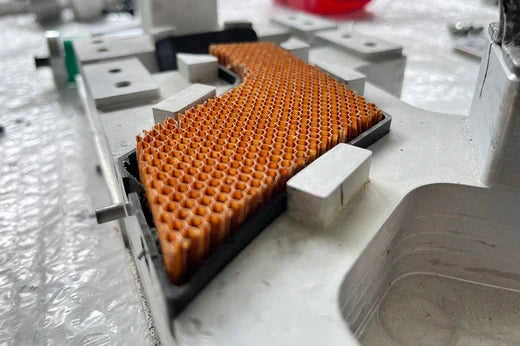
Aramid honeycomb is a lightweight cellular core manufactured from aramid-fiber-based material arranged in a repeating honeycomb geometry.
The individual cells contain mostly air, which allows the core to occupy volume while adding relatively little mass.
Its purpose in a sandwich structure is different from that of the external carbon fiber skins.
Rather than acting as a solid structural material throughout the section, the core separates and supports the outer skins, helping the complete panel resist deformation efficiently.
How Does a Carbon Fiber Sandwich Structure Work?
A typical sandwich composite consists of two relatively thin structural skins separated by a lightweight core.
In a carbon fiber and aramid honeycomb structure, the carbon skins carry much of the tensile and compressive loading associated with bending, while the core maintains the separation between them and transfers shear through the structure.
Increasing the distance between the skins can significantly increase the bending stiffness of the complete section without requiring the entire internal volume to be filled with solid carbon laminate.
This is why sandwich construction can provide a high stiffness-to-weight ratio.
Why Use Aramid Honeycomb Instead of Solid Carbon Fiber?
Adding more carbon fiber layers can increase the thickness and stiffness of a laminate, but it also adds material and mass.
A sandwich structure approaches the problem differently.
By placing lightweight core material between the carbon fiber skins, the overall section can become thicker without a proportional increase in weight.
The objective is not to replace carbon fiber with honeycomb.
The two materials perform complementary functions within the same structure.
Why This Matters in a Gimbal Head
A gimbal head needs to support a camera and telephoto lens while allowing controlled movement around its axes.
Structural components therefore need to provide adequate rigidity without making the head unnecessarily heavy.
This creates a useful application for composite sandwich construction.
Where geometry and loading conditions make it appropriate, carbon fiber skins combined with a lightweight core can provide an efficient way to create structural volume while controlling mass.
For wildlife photographers carrying a tripod, gimbal and large telephoto lens, reducing unnecessary weight in the support system can have a practical benefit in the field.
Structural Rigidity Depends on the Complete Design
The presence of an aramid honeycomb core does not automatically make a component rigid.
Performance depends on the complete structure.
Carbon fiber laminate design, skin thickness, core thickness, geometry, bonding, load direction, local reinforcements and mechanical interfaces all contribute to the behaviour of the finished component.
Areas where bearings, fasteners or other concentrated loads are introduced may also require specific structural solutions.
The core must therefore be considered as part of an engineered composite structure rather than as an isolated material.
What About Vibration?
Honeycomb sandwich construction should not be described simply as a material that eliminates vibration.
The dynamic behaviour of a camera support depends on the complete system, including geometry, mass distribution, structural stiffness, joints, bearings, clamps, tripod legs and the camera and lens mounted on it.
Changing the internal construction of a component can influence its structural behaviour, but vibration performance needs to be evaluated at system level.
For photographic support equipment, this distinction is important because stability cannot be attributed to a single material.
Low Weight Through Geometry
One of the most interesting aspects of honeycomb construction is that its efficiency comes partly from geometry.
The objective is to place material where it contributes effectively to the structure while avoiding unnecessary solid mass.
This is a recurring principle in lightweight engineering.
Instead of asking only which material is strongest or lightest, the designer considers how materials can be arranged to achieve the required mechanical behaviour with an efficient use of mass.
Carbon Fiber and Aramid Honeycomb in Zenelli Components
Zenelli uses composite construction to develop lightweight structural components for photographic support equipment.
Where aramid honeycomb is incorporated into a carbon fiber component, the core and external laminate are designed to work together as a sandwich structure.
The purpose is not simply to make the component lighter.
It is to use the available materials and geometry efficiently while maintaining the structural characteristics required by the application.
More Than a Lightweight Filler
An aramid honeycomb core is not simply empty space inside a carbon fiber component.
It performs a structural function by supporting and separating the external skins within a sandwich construction.
Its effectiveness depends on how the complete component is engineered and manufactured.
In a carbon fiber gimbal or tripod head, aramid honeycomb can provide an efficient way to create structural depth with limited additional mass, helping engineers optimize the relationship between geometry, rigidity and weight.