What Makes a Professional Tripod Different?
At first glance, many camera tripods look remarkably similar.
Most use telescopic legs, many are made from carbon fiber or aluminum, and almost every manufacturer provides specifications for maximum load, height and weight.
But these numbers do not tell the complete story.
A professional tripod is defined by how effectively it controls movement, maintains rigidity, operates consistently and withstands repeated use in real field conditions.
The difference comes from the complete system: leg geometry, materials, locking mechanisms, joints, manufacturing tolerances and the way all these components work together.
Stability Is More Than Load Capacity
Maximum load capacity is one of the most visible tripod specifications, but it should not be interpreted as a direct measurement of stability.
A tripod capable of supporting a heavy static load is not necessarily the most rigid or the most effective at controlling small movements.
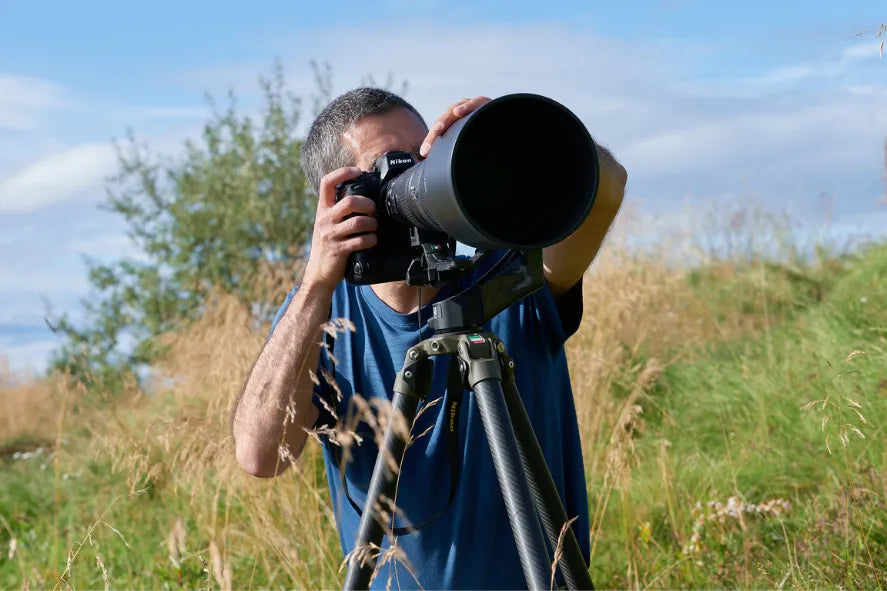
With long and super-telephoto lenses, torsional rigidity becomes particularly important. Forces applied to the camera can produce rotation and flex through the legs, joints and tripod structure even when the equipment is well below the stated maximum load.
For this reason, professional tripod design focuses not only on how much weight the tripod can carry, but also on how the complete structure behaves under that load.
Leg Design and Tube Diameter Matter
Tripod legs are structural components, and their geometry directly influences rigidity.
Tube diameter, wall construction, the number of leg sections and the amount of overlap between telescopic sections all contribute to the behaviour of the tripod.
Larger-diameter tubes can increase stiffness, while additional telescopic sections can make a tripod more compact when folded. These characteristics must therefore be balanced according to the intended use of the tripod.
The smallest leg section is particularly important because the complete structure can only be as effective as the components connecting the camera to the ground.
This is why two carbon fiber tripods of similar weight and height can behave very differently in use.
Carbon Fiber Quality Makes a Difference
Not all carbon fiber tubes are equivalent.
Fiber type, orientation, laminate construction, resin system, wall consistency and manufacturing quality can all influence stiffness, weight and durability.
The objective of using carbon fiber in a professional tripod is not simply to reduce weight. It is to achieve an effective relationship between mass, structural rigidity and vibration behaviour.
For photographers carrying equipment over long distances, reducing unnecessary weight is valuable, but only if the tripod maintains the mechanical characteristics required by the camera and lens system.
The material should therefore be considered as part of the complete tripod design rather than as a guarantee of performance by itself.
The Locking System Is Part of the Structure
Leg locks are sometimes considered mainly from the perspective of speed and convenience, but they also form part of the tripod's structural chain.
When locked, each telescopic section should remain securely connected to the next without unwanted movement.
A professional locking system should provide repeatable clamping while remaining practical to operate in real field conditions.
Its design also affects maintenance. Tripod legs are regularly exposed to dust, moisture, mud and other contaminants, making the construction of the locking mechanism important for long-term reliability.
Precision Engineering Matters
A tripod is an assembly of many mechanical interfaces.
Leg pivots, locking mechanisms, threaded connections, mounting surfaces and machined components all introduce potential movement if they are not manufactured and assembled correctly.
Precision machining and controlled tolerances help maintain alignment and reduce unwanted play between components.
This becomes particularly important after repeated use. A tripod may be opened, closed, transported and adjusted thousands of times during its service life.
Professional equipment should therefore be designed not only to perform correctly when new, but to maintain consistent mechanical behaviour over time.
Height and Rigidity Are Connected
Maximum height is useful, but extending a tripod changes its mechanical behaviour.
As the legs extend and smaller-diameter sections come into use, the structure generally becomes less rigid than when the tripod is operating at a lower height.
This does not mean that maximum extension should be avoided. It means that tripod height should be considered together with the equipment being supported and the conditions in which it will be used.
A professional tripod should provide the required working height while maintaining an appropriate balance between rigidity, portability and weight.
Reliability in Real Field Conditions
Outdoor photography exposes support equipment to rain, dust, mud, sand, snow and temperature changes.
Tripod feet contact the ground directly, leg sections are repeatedly extended and retracted, and locking mechanisms operate in conditions that are very different from a controlled indoor environment.
Professional tripod design therefore needs to consider contamination, drainage, maintenance and repeated operation as part of normal use.
Durability is not simply the ability to survive a single difficult situation. It is the ability to maintain predictable operation after repeated exposure to real field conditions.
Serviceability Matters
Professional equipment is often expected to remain in use for many years.
For this reason, maintenance and serviceability should be considered part of the design.
Components subject to wear should be accessible where appropriate, replacement parts should be available, and the tripod should be capable of being inspected and maintained rather than treated as a disposable product.
Long-term ownership depends not only on the initial quality of the equipment but also on the ability to keep it operating correctly.
What Should You Look for in a Professional Tripod?
When comparing professional tripods, specifications such as weight, maximum height and load capacity remain useful, but they should be considered together rather than individually.
Look at the diameter and construction of the leg sections, the rigidity of the complete structure, the locking system, the quality of the mechanical interfaces, the materials used, the tripod's behaviour at different extensions and the possibility of maintaining it over time.
Most importantly, consider how these characteristics relate to your actual equipment and photography.
A photographer using a large super-telephoto lens from a fixed position has different requirements from someone carrying a tripod for several kilometres through the mountains.
A Tripod Is a Complete Mechanical System
The difference between a standard tripod and a professional tripod cannot be reduced to a single specification.
It comes from the interaction between materials, geometry, manufacturing precision, locking mechanisms, structural rigidity, weight and long-term reliability.
At Zenelli, these principles guide the development of our carbon fiber tripods. Rather than considering individual specifications in isolation, we approach the tripod as a complete mechanical system connecting the camera and lens to the ground.
For photographers, this leads to a more useful way of comparing tripods.
Instead of asking only “How much weight can this tripod support?”, it is worth asking “How will this tripod behave with my equipment, in the conditions where I actually photograph?”