

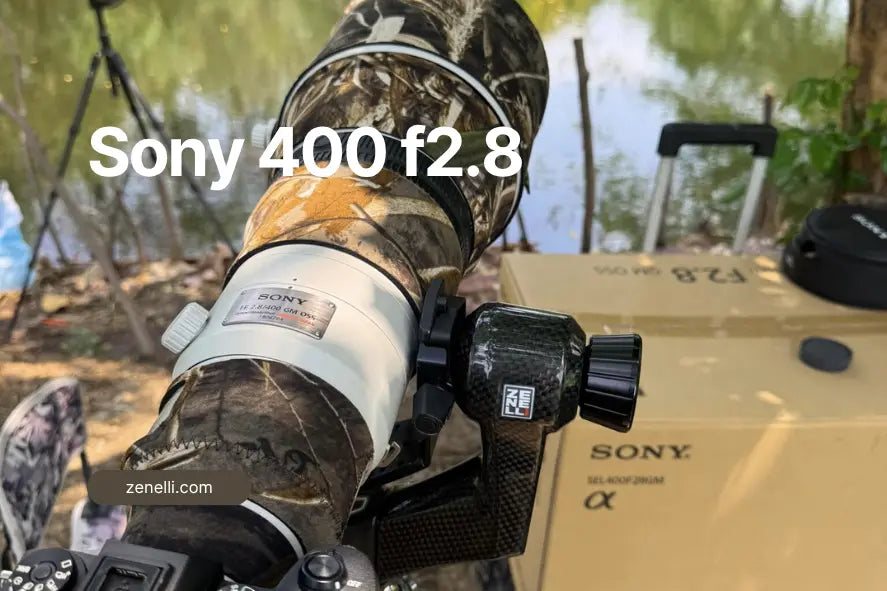
Gimbal Head for a 400mm f/2.8 Lens – Field Test with Sony 400mm and Zenelli CARBON ZC
A 400mm f/2.8 is a demanding lens for any support system. Its size, weight and long physical structure make correct balance particularly important, especially when the camera needs to move quickly between subjects.
We tested the Sony FE 400mm F2.8 GM OSS with a Sony α1 and Zenelli CARBON ZC gimbal head in two very different situations: field sports and wildlife photography.
The objective was not simply to evaluate whether the gimbal could support the equipment. A suitable gimbal for a 400mm f/2.8 needs to allow the complete camera and lens combination to be balanced around the tilt axis while providing smooth pan and tilt movement during tracking.
Why a 400mm f/2.8 Benefits from a Gimbal Head
With a large telephoto lens, load capacity alone does not determine whether a support system will work well.
What matters is the ability to position the combined center of gravity of the camera and lens in relation to the gimbal's axes of rotation.
When correctly balanced, a 400mm f/2.8 can remain close to neutral as it is tilted upward or downward. The photographer therefore does not need to continuously counteract the weight of the lens while tracking a subject.
This is particularly useful when the camera must remain ready for long periods or when subjects change direction quickly.
Sony 400mm f/2.8 and CARBON ZC Setup
For this field test, we used a Sony α1 with the Sony FE 400mm F2.8 GM OSS mounted on the Zenelli CARBON ZC and supported by a tripod.
The CARBON ZC uses a compact gimbal architecture designed to provide both vertical and longitudinal adjustment.
Longitudinal adjustment allows the lens to move forward or backward until its center of gravity is positioned correctly. Vertical adjustment brings the lens into the appropriate relationship with the tilt axis.
With both adjustments correctly set, the lens can move through its working range without the photographer constantly supporting its weight.
Tracking Fast Action with a 400mm Lens
We first used the combination on the sidelines of a youth soccer match.
This type of photography requires frequent changes in direction. The subject may move horizontally across the field and then suddenly approach or move away from the camera.
A gimbal allows pan and tilt movements to occur independently or simultaneously, making it possible to follow these changes without repositioning the entire support.
With the 400mm f/2.8 correctly balanced on the CARBON ZC, the system could be moved with relatively little input from the photographer. Instead of physically holding the lens against gravity, the hands could primarily guide its direction.
This distinction becomes increasingly noticeable during extended shooting sessions.
Using the Same Setup for Wildlife Photography
Wildlife photography presents a different challenge.
Movement can be much slower, and the camera may remain pointed toward the same area for extended periods before the subject moves.
Here, correct balance becomes useful for another reason. The photographer can leave the lens positioned without continuously supporting its mass while still being ready to follow an animal when it begins to move.
Small, controlled movements are particularly important at 400mm, where changes in camera direction translate into significant changes in framing.
The objective is therefore not simply maximum freedom of movement, but controlled movement with predictable resistance.
Compact Gimbal or Full-Size Gimbal for a 400mm f/2.8?
A 400mm f/2.8 does not automatically require the largest possible gimbal head.
The more important questions are whether the head provides sufficient adjustment range for the lens, adequate clearance throughout the required tilt range, appropriate rigidity and secure mounting.
A compact gimbal such as the CARBON ZC can therefore be a practical solution for a 400mm f/2.8 when the complete camera and lens combination can be correctly balanced within its adjustment range.
A more compact support also reduces the amount of equipment that needs to be carried between shooting locations.
What Matters When Choosing a Gimbal for a 400mm Lens
When selecting a gimbal head for a 400mm f/2.8, the manufacturer's maximum load specification should not be the only consideration.
The head needs sufficient longitudinal adjustment to balance the camera and lens and enough vertical adjustment to correctly position the system relative to the tilt axis. It should also provide adequate clearance throughout the required movement, smooth and controllable pan and tilt, sufficient structural rigidity and a secure interface with the lens foot or quick-release plate.
Overall system weight also matters, particularly when the equipment needs to be carried between locations or used for extended periods.
A head capable of carrying a heavy static load is not necessarily optimized for controlling a large telephoto lens in motion.
Field Test Conclusion
The Sony 400mm f/2.8 GM OSS and Sony α1 represent a substantial camera system, but correct gimbal balance changes how that mass is managed.
During sports photography, the main advantage was the ability to follow rapidly changing movement without continuously supporting the lens against gravity. During wildlife photography, the same balance provided controlled positioning and reduced the physical effort required while waiting and tracking.
The Zenelli CARBON ZC demonstrated that a compact gimbal can be suitable for a professional 400mm f/2.8 setup when it provides the necessary adjustment range, clearance and structural rigidity.
For photographers choosing a support for a 400mm lens, the key question is therefore not simply “How much weight can the head support?”
It is “Can the complete camera and lens system be correctly balanced and controlled throughout the movements I need to make?”

